Old Testament
1 Kings 10:16
Read the Bible in clear, modern English—easy to understand, faithful to the meaning, and written for everyday readers.
King Solomon made 200 large shields of hammered gold, using 600 shekels of gold for each shield.
Compare translations
And king Solomon made two hundred targets of beaten gold: six hundred shekels of gold went to one target.
What 1 Kings 10:16 means
Plain-English insight for readers
In this passage, we see King Solomon's wealth and power displayed through the creation of 200 large shields made of hammered gold. Each shield required a significant amount of gold, specifically 600 shekels, showcasing not only his resources but also his desire to impress. These shields were likely used for ceremonial purposes, symbolizing strength and protection. Solomon's reign was marked by prosperity, and these golden shields served as a testament to his achievements. The sheer quantity and quality of the gold reflect the grandeur of his kingdom. This moment highlights the importance of leadership and the responsibility that comes with great wealth. Solomon's choices in how he displayed his riches can inspire us to consider how we use our own resources. Are we using what we have to uplift and inspire others, or merely to show off? Reflecting on Solomon's actions can lead us to think about the legacy we want to leave behind, both in our personal lives and in our communities.
How to apply 1 Kings 10:16 to your life
Consider how you use your resources, whether they are time, money, or talents. Are you using them to benefit others and create a positive impact? Like Solomon, think about the legacy you want to leave and how your choices reflect that vision. Small acts of generosity can lead to significant change in your community. Reflect on your priorities and make adjustments as needed to align with your values and goals.
Curated for this public verse page. 1 Kings Summary
Learn the Bible through its people and places
Get to know the people in Scripture through illustrated stories, and explore the places where they lived and traveled.
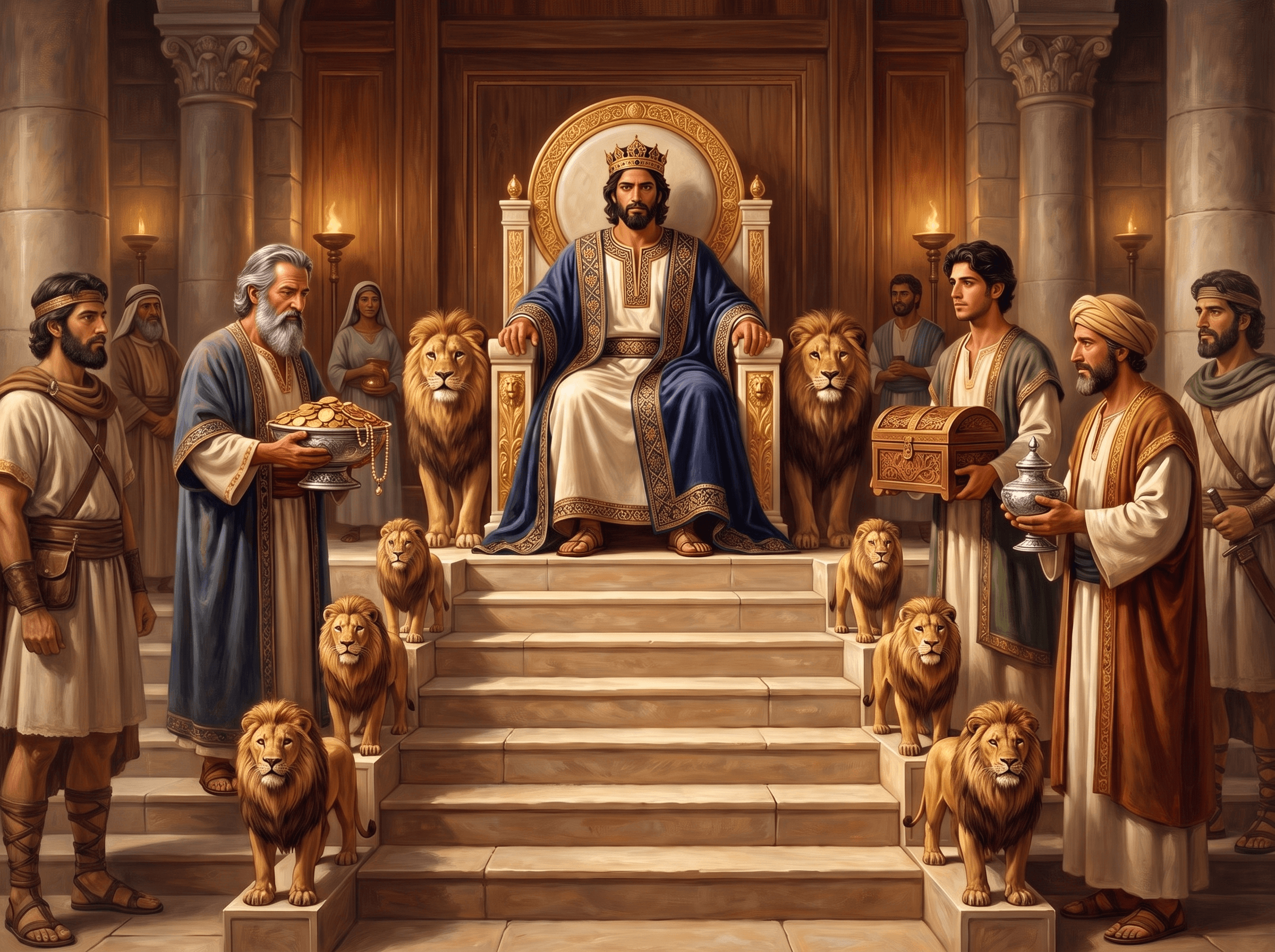
Illustrated scene from Solomon's story: Solomon's Riches (1 Kings 10:14–29)
Meet the people of the Bible
Follow their lives in order, with illustrated scenes and Bible passages that tell their stories.
 Solomon

Photo: Photochrom print, Library of Congress Prints and Photographs Division (LCCN 2002725043). License: Public domain in the United States; Library of Congress states no known restrictions on publication. Source. Location: Nablus and Mount Gerizim, West Bank; print preserved by the Library of Congress. Resized for the web.
Explore the places of the Bible
See where biblical events happened, why each place matters, and what archaeology helps us understand.
Shechem
Where God promised the land to Abram, and where Joshua led Israel to renew the covenant.
Get full access with one subscription
Explore the people and places of the Bible. Read summaries of every book, with images and clear explanations covering every chapter. Access all these features and our Bible study tools with one subscription.
See PlansAsk AI about 1 Kings 10:16
Ask a question about this verse and get a clear answer, with Bible references you can read for yourself.
Every Bible book, explained chapter by chapter
Explore summaries of every book of the Bible, with images and easy-to-understand explanations covering every chapter.
Keep studying 1 Kings 10:16
Related Bible verses
Key themes
Related topics
At a Glance — the Book of 1 Kings
- Author
- Author unknown; possibly Jeremiah
- Written
- Around 560 BC
- Genre
- Historical narrative
- Original Audience
- Exiled Israelites in Babylon
Frequently Asked Questions
Quick, clear answers about this verse
What does 1 Kings 10:16 reveal about Solomon's wealth?
1 Kings 10:16 highlights King Solomon's immense wealth by describing the creation of 200 large shields made of hammered gold. Each shield required 600 shekels of gold, indicating not only his financial resources but also his desire to display power and opulence. This passage serves as a testament to the prosperity of his reign and the grandeur of his kingdom.
Why did Solomon make golden shields?
Solomon made golden shields likely for ceremonial purposes, symbolizing strength, protection, and the glory of his reign. These shields were not just functional but also served as a display of wealth and power, reinforcing his status as a formidable leader. They represented the prosperity of Israel during his rule and were likely used in royal ceremonies or to impress visiting dignitaries.
What can we learn from Solomon's use of resources?
From Solomon's creation of golden shields, we can learn the importance of how we use our resources. While Solomon showcased his wealth, it prompts us to reflect on our own choices. Are we using our time, money, and talents to uplift others and create a positive impact? This verse encourages us to consider our legacy and how our actions can inspire and benefit our communities.
How does 1 Kings 10:16 relate to leadership?
1 Kings 10:16 illustrates a key aspect of leadership: the responsibility that comes with wealth and power. Solomon's decision to create lavish golden shields reflects his role as a leader who not only governs but also sets an example. Effective leadership involves using one's resources wisely and ethically, ensuring that they contribute to the greater good rather than mere self-indulgence.
Daily Verse — straight to your inbox
A verse and a 2-sentence plain-English explanation, every morning. Free. Unsubscribe anytime.