New Testament
Luke 23:20
Read the Bible in clear, modern English—easy to understand, faithful to the meaning, and written for everyday readers.
Pilate wanted to release Jesus, so he appealed to the crowd again.
Compare translations
Pilate therefore, willing to release Jesus, spake again to them.
What Luke 23:20 means
Plain-English insight for readers
In this verse, we see Pilate, the Roman governor, who is in a difficult position regarding Jesus' fate. Despite the pressure from the crowd to condemn Jesus, Pilate is inclined to set Him free. This shows Pilate's internal conflict; he recognizes Jesus' innocence but is also aware of the crowd's demands. Pilate's repeated appeals to the crowd indicate his desire to avoid injustice and to uphold what he believes is right. This moment highlights the tension between authority and public opinion, as well as the struggle to do what is morally right in the face of societal pressure. Pilate's actions reflect a common human experience: the challenge of standing up for one's beliefs when confronted with overwhelming opposition. His willingness to speak again to the crowd suggests a hope that they might reconsider their stance, revealing his desire for justice and truth to prevail, even in a politically charged environment.
How to apply Luke 23:20 to your life
This verse encourages us to stand firm in our beliefs, even when faced with pressure from others. Like Pilate, we may encounter situations where doing the right thing is challenged by popular opinion. It reminds us to seek justice and truth, regardless of the consequences.
Curated for this public verse page. Luke Summary
Learn the Bible through its people and places
Get to know the people in Scripture through illustrated stories, and explore the places where they lived and traveled.
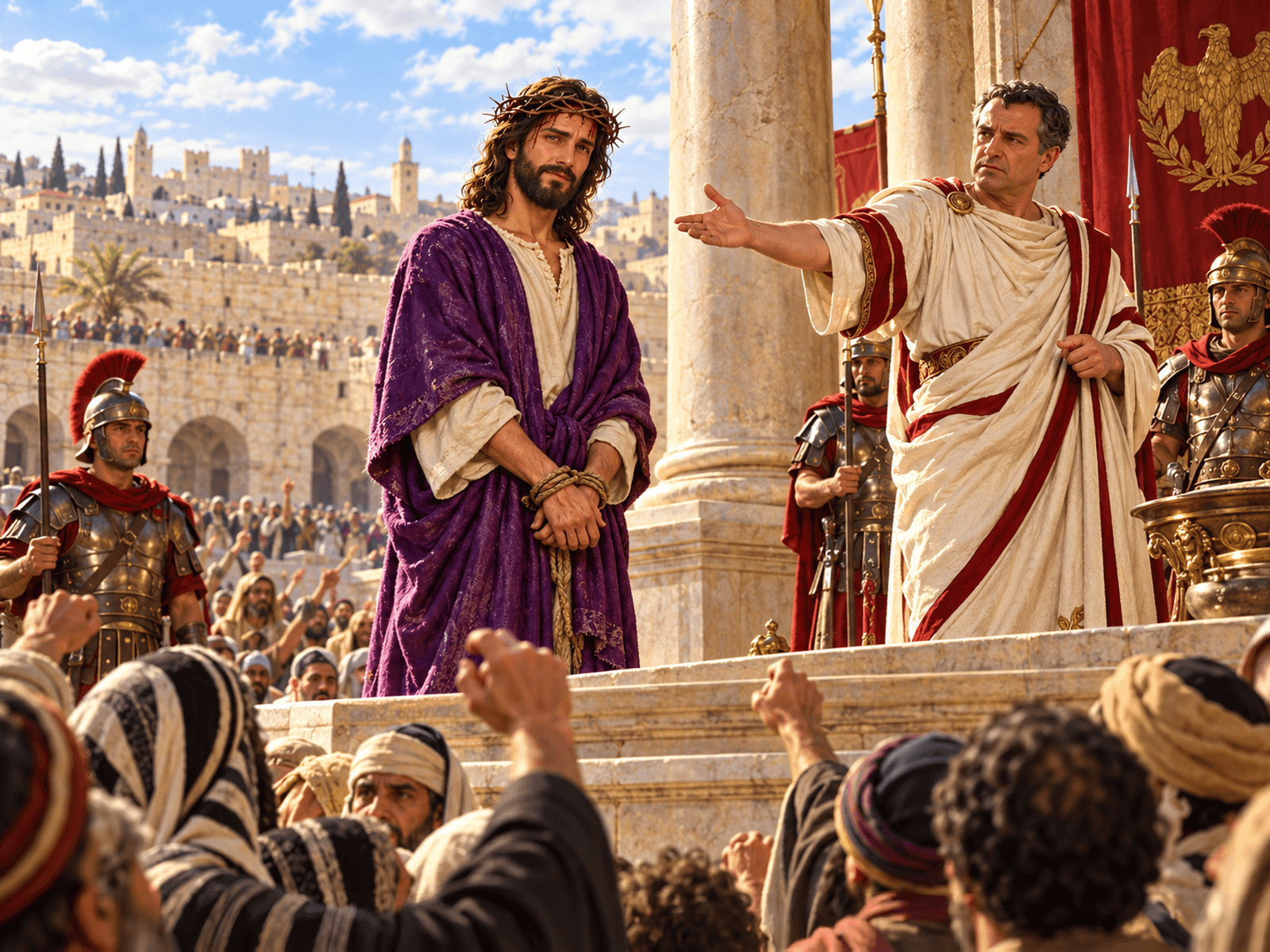
Illustrated scene from Jesus's story: On Trial Before Pilate (Luke 23:1–25)
Meet the people of the Bible
Follow their lives in order, with illustrated scenes and Bible passages that tell their stories.
 Jesus

Photo: Photochrom print, Library of Congress Prints and Photographs Division (LCCN 2002724966). License: Public domain in the United States; Library of Congress states no known restrictions on publication. Source. Location: Bethlehem, West Bank; print preserved by the Library of Congress. Resized for the web.
Explore the places of the Bible
See where biblical events happened, why each place matters, and what archaeology helps us understand.
Bethlehem
David's hometown, and the town where Jesus was born.
Get full access with one subscription
Explore the people and places of the Bible. Read summaries of every book, with images and clear explanations covering every chapter. Access all these features and our Bible study tools with one subscription.
See PlansAsk AI about Luke 23:20
Ask a question about this verse and get a clear answer, with Bible references you can read for yourself.
Every Bible book, explained chapter by chapter
Explore summaries of every book of the Bible, with images and easy-to-understand explanations covering every chapter.
Keep studying Luke 23:20
Related Bible verses
At a Glance — the Book of Luke
- Author
- Luke the physician
- Written
- Around AD 60-62
- Genre
- Gospel and history
- Original Audience
- Gentile Christians (addressed to Theophilus)
Frequently Asked Questions
Quick, clear answers about this verse
What does Luke 23:20 mean?
Luke 23:20 shows Pilate's struggle as he tries to release Jesus despite the crowd's demands for His condemnation. It highlights the conflict between Pilate's recognition of Jesus' innocence and the pressure from the public.
What is the significance of Pilate's appeal to the crowd in Luke 23:20?
Pilate's appeal to the crowd signifies his desire to uphold justice while navigating the political pressures of his role. It illustrates the tension between authority and public opinion during a critical moment.
What does the phrase 'willing to release Jesus' indicate in Luke 23:20?
The phrase 'willing to release Jesus' indicates Pilate's inclination to do what he believes is right, recognizing Jesus' innocence, despite the overwhelming pressure from the crowd to condemn Him.
How does Luke 23:20 reflect moral conflict?
Luke 23:20 reflects moral conflict by showcasing Pilate's internal struggle between his duty as a governor and his understanding of justice. He is caught between the truth of Jesus' innocence and the demands of the crowd.
Daily Verse — straight to your inbox
A verse and a 2-sentence plain-English explanation, every morning. Free. Unsubscribe anytime.