New Testament
Matthew 27:17
Read the Bible in clear, modern English—easy to understand, faithful to the meaning, and written for everyday readers.
So when the crowd had gathered, Pilate asked them, "Who do you want me to release — Barabbas, or Jesus who is called Christ?"
Compare translations
Therefore when they were gathered together, Pilate said unto them, Whom will ye that I release unto you? Barabbas, or Jesus which is called Christ?
What Matthew 27:17 means
Plain-English insight for readers
In this verse, we see a pivotal moment during the trial of Jesus. Pilate, the Roman governor, is faced with a decision that reflects the tension between justice and public opinion. He presents the crowd with a choice between Barabbas, a notorious criminal, and Jesus, who is known as the Christ, or the Messiah. This choice symbolizes the people's rejection of Jesus, despite His innocence and the good He has done. The crowd's response will ultimately lead to Jesus' crucifixion, highlighting the theme of sacrifice and the fulfillment of prophecy. Pilate's question also reveals the power of the crowd and the influence of societal pressure in decision-making. This moment serves as a reminder of the choices we face in our own lives and the importance of standing for what is right, even when it is unpopular.
How to apply Matthew 27:17 to your life
This verse encourages us to reflect on the choices we make and the influences that shape them. It challenges us to stand firm in our beliefs, even when faced with societal pressure. We should strive to choose what is right and just, following the example of Christ.
Curated for this public verse page. Matthew Summary
Learn the Bible through its people and places
Get to know the people in Scripture through illustrated stories, and explore the places where they lived and traveled.
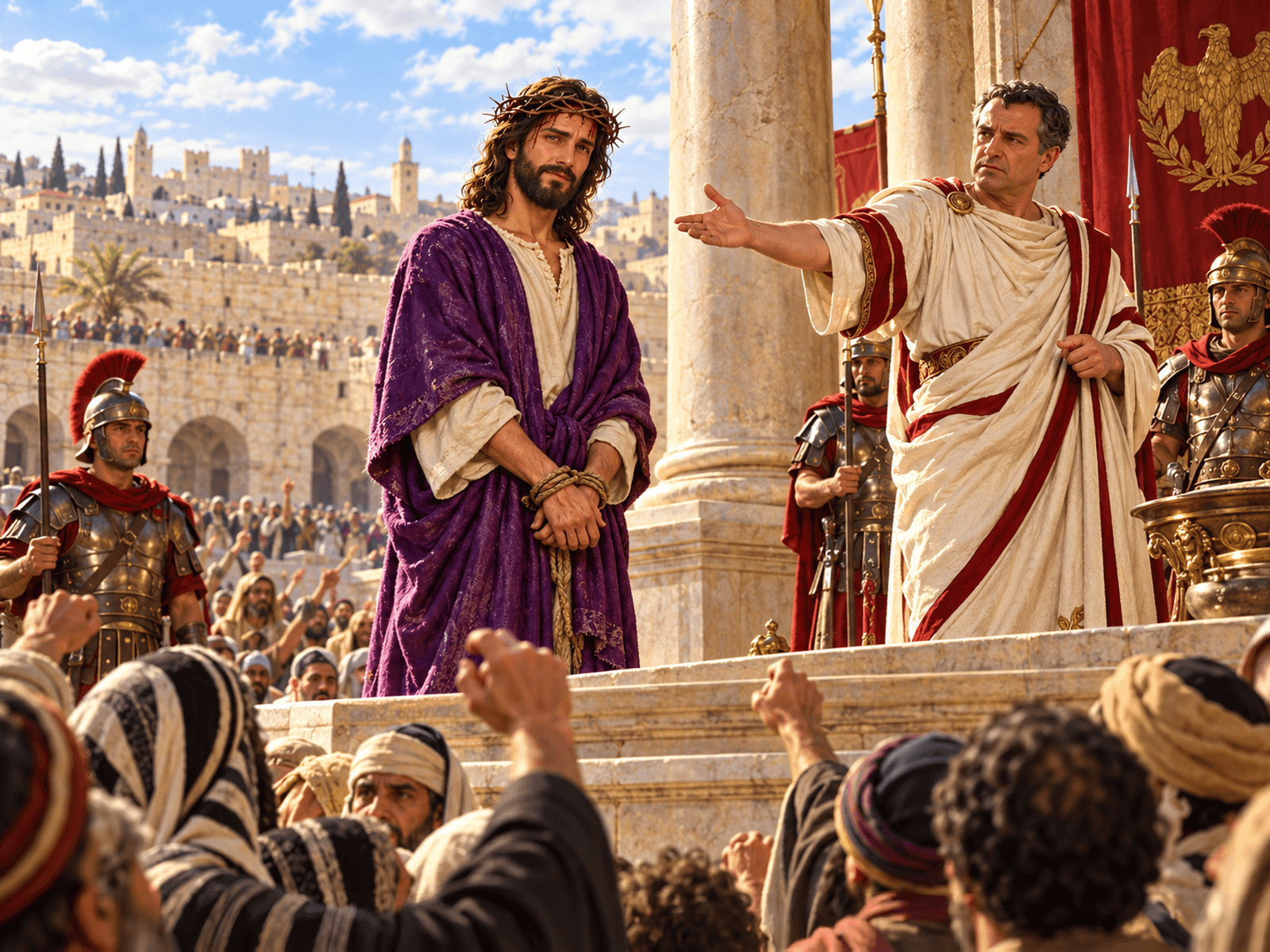
Illustrated scene from Jesus's story: On Trial Before Pilate (Matthew 27:11–31)
Meet the people of the Bible
Follow their lives in order, with illustrated scenes and Bible passages that tell their stories.
 Jesus

Photo: Photochrom print, Library of Congress Prints and Photographs Division (LCCN 2002725045). License: Public domain in the United States; Library of Congress states no known restrictions on publication. Source. Location: Nazareth, Israel; print preserved by the Library of Congress. Resized for the web.
Explore the places of the Bible
See where biblical events happened, why each place matters, and what archaeology helps us understand.
Nazareth
The small town in Galilee where Jesus grew up.
Get full access with one subscription
Explore the people and places of the Bible. Read summaries of every book, with images and clear explanations covering every chapter. Access all these features and our Bible study tools with one subscription.
See PlansAsk AI about Matthew 27:17
Ask a question about this verse and get a clear answer, with Bible references you can read for yourself.
Every Bible book, explained chapter by chapter
Explore summaries of every book of the Bible, with images and easy-to-understand explanations covering every chapter.
Keep studying Matthew 27:17
Related Bible verses
At a Glance — the Book of Matthew
- Author
- Matthew the apostle
- Written
- Around AD 60-70
- Genre
- Gospel
- Original Audience
- Jewish Christians
Frequently Asked Questions
Quick, clear answers about this verse
What does Matthew 27:17 mean?
Matthew 27:17 presents a critical moment where Pilate offers the crowd a choice between Barabbas, a criminal, and Jesus, referred to as Christ. This choice highlights the people's rejection of Jesus and sets the stage for His crucifixion.
What is the significance of Barabbas in Matthew 27:17?
Barabbas represents the choice of sin and rebellion against authority, contrasting with Jesus, who embodies innocence and righteousness. The crowd's preference for Barabbas over Jesus illustrates the theme of societal pressure and moral failure.
What does Pilate's question reveal in Matthew 27:17?
Pilate's question reveals the tension between justice and public opinion, as he seeks to gauge the crowd's desire. It underscores the influence of the masses in decision-making, especially regarding justice.
What themes are present in Matthew 27:17?
Key themes in Matthew 27:17 include choice, innocence, public opinion, sacrifice, rejection, and justice. These themes reflect the moral dilemmas faced by individuals and societies.
Daily Verse — straight to your inbox
A verse and a 2-sentence plain-English explanation, every morning. Free. Unsubscribe anytime.