Paul's Story · Event 22 of 42
To an Unknown God
The Second Journey · Athens
Acts 17:16–34
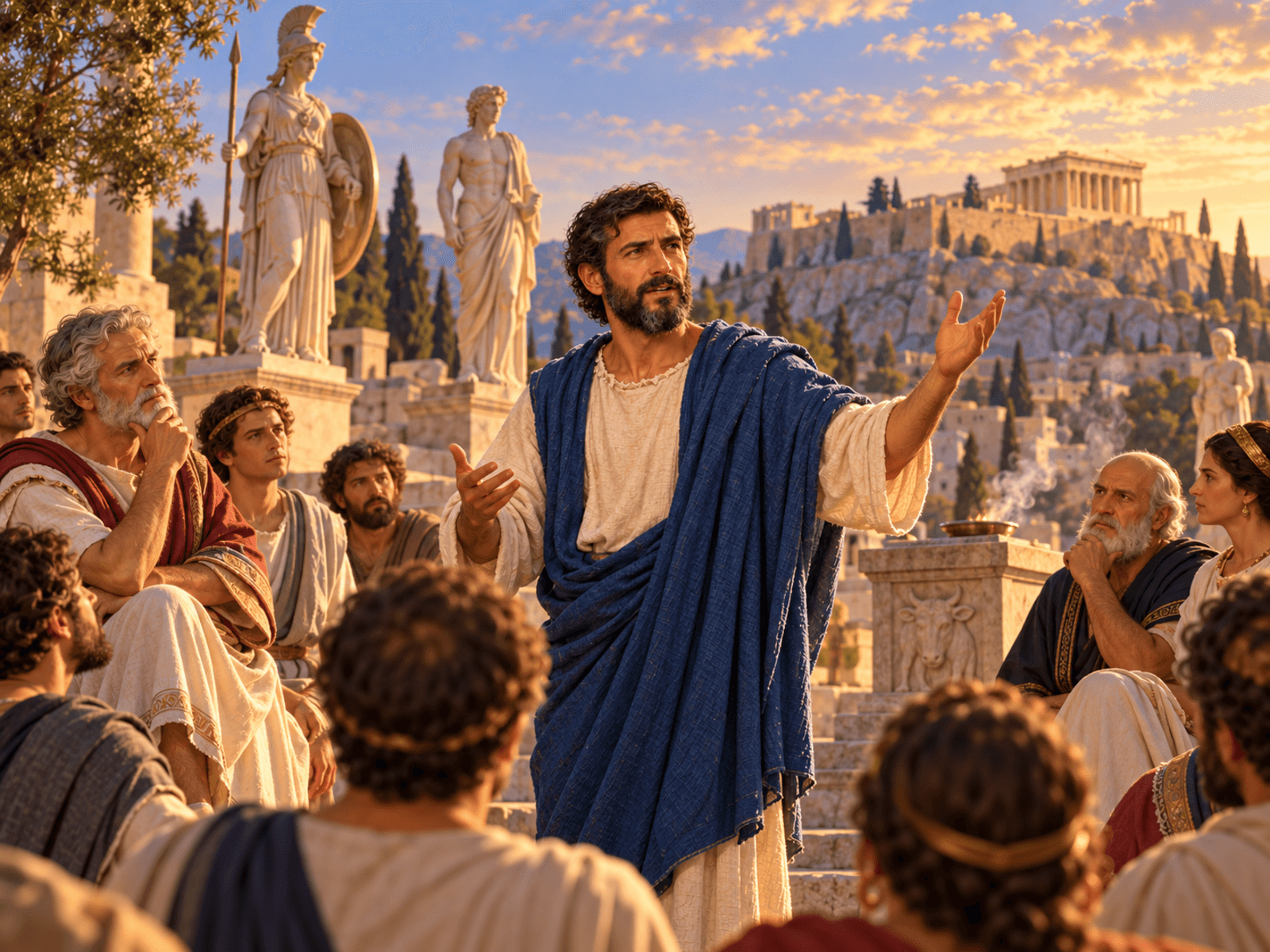
16While Paul was waiting for them in Athens, his spirit was provoked within him when he saw that the city was full of idols. 17So he reasoned in the synagogue with the Jews and the devout persons, and in the marketplace every day with those who met with him. 18Some Epicurean and Stoic philosophers began engaging with him. Some said, 'What is this babbler trying to say?' Others said, 'He seems to be a promoter of foreign gods' — because he was preaching Jesus and the resurrection. 19They took him and brought him to the Areopagus, saying, 'May we know what this new teaching is that you are presenting? 20You are bringing some strange things to our ears, and we want to know what these things mean.' 21(For all the Athenians and the foreigners living there spent their time in nothing else but telling or hearing something new.) 22Paul stood in the middle of the Areopagus and said, 'Men of Athens, I can see that in every way you are very religious. 23For as I walked around and observed your objects of worship, I even found an altar with this inscription: TO THE UNKNOWN GOD. What you worship without knowing — him I proclaim to you. 24The God who made the world and everything in it, being Lord of heaven and earth, does not dwell in temples made with hands. 25Nor is he served by human hands as though he needed anything, since he himself gives to all people life, breath, and all things. 26From one blood he made every nation of people to dwell on the whole face of the earth, having determined their appointed times and the boundaries of where they would live, 27so that they would seek the Lord, if perhaps they might grope for him and find him — though he is not far from each one of us. 28For in him we live and move and have our being, as some of your own poets have said, 'For we are also his offspring.' 29Since then we are God's offspring, we should not think that the divine nature is like gold, silver, or stone — an image crafted by human art and imagination. 30God overlooked the times of such ignorance, but now he commands all people everywhere to repent, 31because he has set a day on which he will judge the world in righteousness through a man whom he has appointed. He has given proof of this to everyone by raising him from the dead.' 32When they heard about the resurrection of the dead, some mocked, while others said, 'We will hear you again about this.' 33So Paul departed from among them. 34However, some men joined him and believed, among whom were Dionysius the Areopagite, a woman named Damaris, and others with them.