What Does Habakkuk 2:4 Mean?
Habakkuk 2:4 meaning explains how the righteous survive through faith while the proud fall, establishing the biblical principle of justification by faith.
Clear Bible Translation
Modern English"Look — the one whose soul is puffed up with pride has no integrity. But the righteous person will live by his faith."
King James Version
Behold, his soul which is lifted up is not upright in him: but the just shall live by his faith.
Language, Structure, and Intent
Habakkuk 2:4 contrasts two responses to God's delayed justice: prideful self-reliance versus faithful dependence on God. The 'puffed up' person represents the Babylonians who trust in their own power and lack moral integrity, while 'the righteous' refers to faithful Israelites who will survive through unwavering trust in God's promises. This verse establishes the principle of justification by faith, declaring that spiritual life comes not from human achievement but from faithful reliance on God. God speaks this oracle directly to Habakkuk as the climactic answer to the prophet's complaints about divine justice.
The prophet Habakkuk wrote to Judah around 605-600 BC as the Babylonian Empire was rising to destroy Jerusalem and exile God's people.
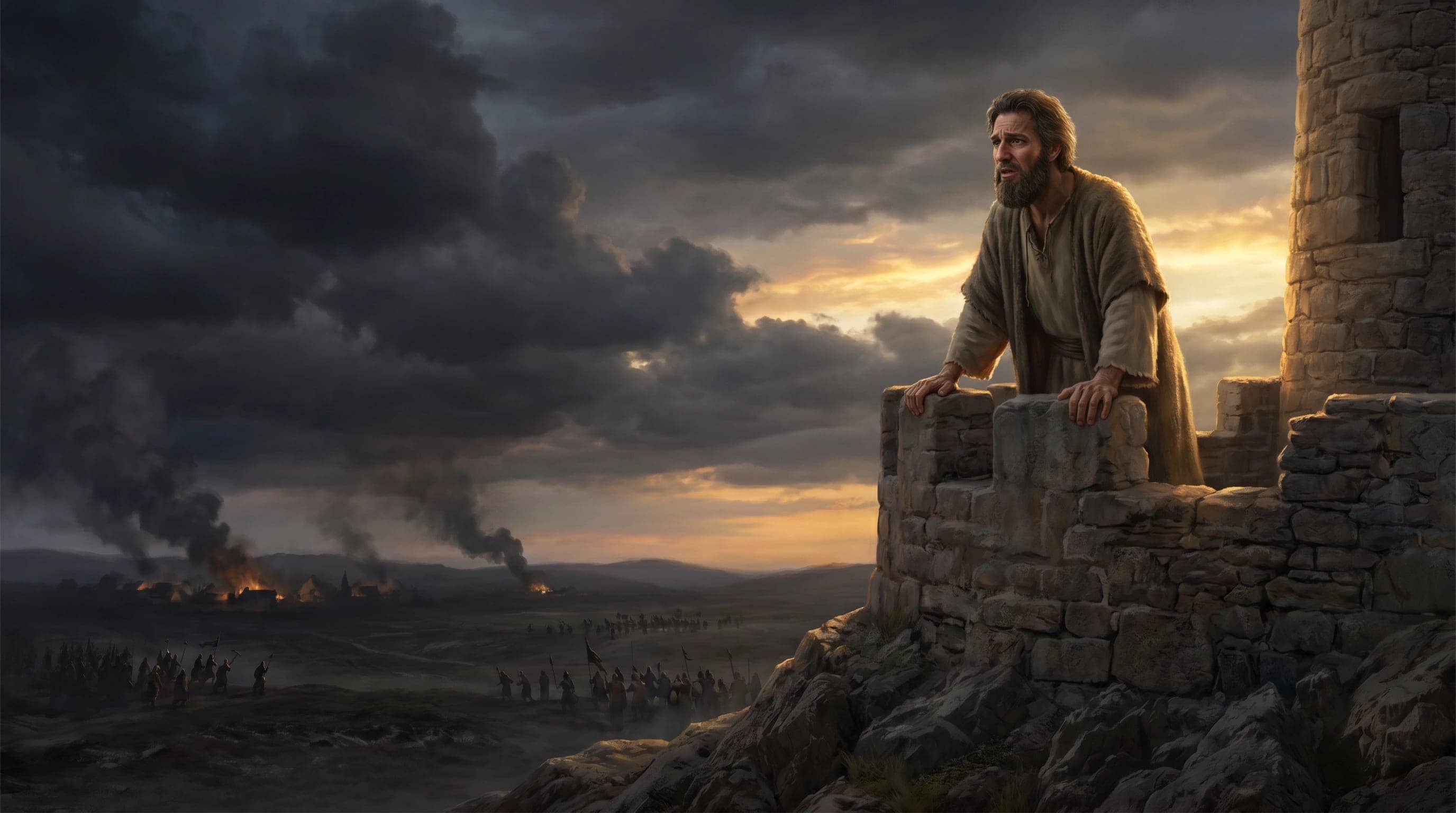
Habakkuk has questioned why God allows the wicked Babylonians to oppress righteous Judah, and God responds with a vision that must be written down for future generations. Verse 4 serves as the theological foundation for five 'woe' oracles against Babylon that follow in verses 5-20, contrasting the proud oppressor's ultimate doom with the faithful remnant's survival. The prophet has positioned himself as a watchman waiting for God's response, and this verse delivers the central principle that will sustain God's people through the coming Babylonian exile. The vision emphasizes that though God's justice may be delayed, the righteous will endure through faith while the proud will fall.
Read the full chapter: Habakkuk 2 →
Present-Day Relevance
When facing circumstances where evil seems to prosper and justice appears delayed, believers must choose between self-reliant pride and faithful dependence on God's character and promises. This verse calls for patient trust in God's ultimate justice rather than taking matters into our own hands or becoming cynical about God's goodness.
Connected Passages
The Book of Habakkuk
Habakkuk 1: Habakkuk's Complaint and the LORD's Answer
The burden that Habakkuk the prophet sees begins with his complaint to the LORD. Habakkuk asks how long he must cry out about violence without being heard. He says destruction and strife surround him, the law is ignored, and justice never moves forward. The wicked surround the righteous, and judgment comes out twisted.
Unlock the full Habakkuk summary
Continue reading every chapter — themes, structure, and turning points.
The complete summary of Habakkuk — a chapter-by-chapter breakdown covering all 3 chapters.
What you get
Every chapter of Habakkuk summarized in clear, modern English
How each section connects — narrative flow, key themes, and turning points
Permanent access — read anytime, on any device
All 66 book summaries • unlimited AI tools • $99/year after trial
ClearBible summaries are proprietary content and may not be copied, republished, or resold.
Reader Questions
- What is the historical background of Habakkuk 2:4?
- The prophet Habakkuk wrote to Judah around 605-600 BC as the Babylonian Empire was rising to destroy Jerusalem and exile God's people.
- What is the main theme of Habakkuk 2:4?
- The primary theme is justification by faith. Related themes include divine justice and pride versus humility and perseverance under trial.
- Where is Habakkuk 2:4 in the Bible?
- Habakkuk, chapter 2, verse 4. Read Habakkuk 2 →
Daily Verse — straight to your inbox
A verse and a 2-sentence plain-English explanation, every morning. Free. Unsubscribe anytime.