Jump to section
- What Is an Interlinear Bible?
- What Does an Interlinear Bible Look Like?
- What Languages Were the Bible Originally Written In?
- How Does an Interlinear Bible Work?
- What Is Transliteration?
- What Is a Lemma?
- What Are Strong’s Numbers?
- What Is a Bible Lexicon?
- Interlinear Bible vs. Strong’s Concordance vs. Bible Lexicon
- Traditional Interlinear vs. Reverse Interlinear Bible
- Can You Study Hebrew and Greek Without Knowing Hebrew or Greek?
- What an Interlinear Bible Can Tell You
- What an Interlinear Bible Cannot Tell You by Itself
- The Biggest Mistake People Make With Interlinear Bibles
- A Real Example: Studying One Bible Verse With an Interlinear
- How Modern Bible Study Goes Beyond a Traditional Interlinear
- How ClearBible.ai Approaches Original-Language Study
- What an Interlinear Bible Can and Cannot Tell You
- Frequently Asked Questions
- What is an interlinear Bible?
- What does “interlinear” mean in the Bible?
- What is the difference between an interlinear Bible and a regular Bible?
- What is a reverse interlinear Bible?
- Can I understand biblical Greek or Hebrew without learning the language?
An interlinear Bible places the Bible's original Hebrew or Greek text directly alongside an English translation, word by word. Have you ever wanted to see what a verse actually says in its original language, without learning Hebrew or Greek yourself? An interlinear Bible is where that kind of original language Bible study begins.
This guide explains exactly what an interlinear Bible is, how to read one, and — just as important — what it cannot do for you by itself. Along the way you will learn what transliteration and a lemma are, and how Strong's Numbers work. You will see how a Greek and Hebrew Bible differs from the English Bible on your shelf. You will also learn the single most common mistake ordinary readers make when they start digging into the original languages.
What Is an Interlinear Bible?
An interlinear Bible displays the Bible's original Hebrew or Greek text together with a corresponding English translation, arranged word by word. It lets you see exactly which original-language word stands behind a given English word or phrase, without requiring you to read Hebrew or Greek yourself.
That sounds simple, and in one sense it is. But it is a tool for examining evidence, not a machine that hands you a final answer. Everything after this section is about how to use that evidence responsibly.
What Does an Interlinear Bible Look Like?
Open any interlinear and you will typically find several layers of information stacked on or below each original word. None of them is complicated on its own — together, they let you trace an English translation back to its source.
| Item | Example (John 3:16) | What It Means | Why It Matters |
|---|---|---|---|
| Original word | ἠγάπησεν | The actual Hebrew or Greek text the author wrote | This is the primary evidence — everything else is built on it |
| Transliteration | ēgapēsen | The word's sound, spelled with English letters | Lets you recognize and pronounce it without reading Greek or Hebrew script |
| Lemma | ἀγαπάω (agapaō) | The word's dictionary, or "root," form | Lexicons and Strong's entries are organized by lemma, not by every inflected spelling |
| English gloss | "loved" | A short English equivalent for this occurrence | Shows the specific translation choice made for this verse |
| Strong's Number | G25 | An index number pointing to one dictionary entry | Lets you find the lexicon entry and locate other verses that use the same word |
| Morphology | Verb, aorist active indicative, 3rd person singular | The word's grammatical form in this exact verse | Tense, voice, and mood are real evidence for what the word is doing here |
Some interlinears show all six layers. Others show only two or three. Either way, the goal is the same: connect the English translation you're reading back to the specific Hebrew or Greek word it came from.
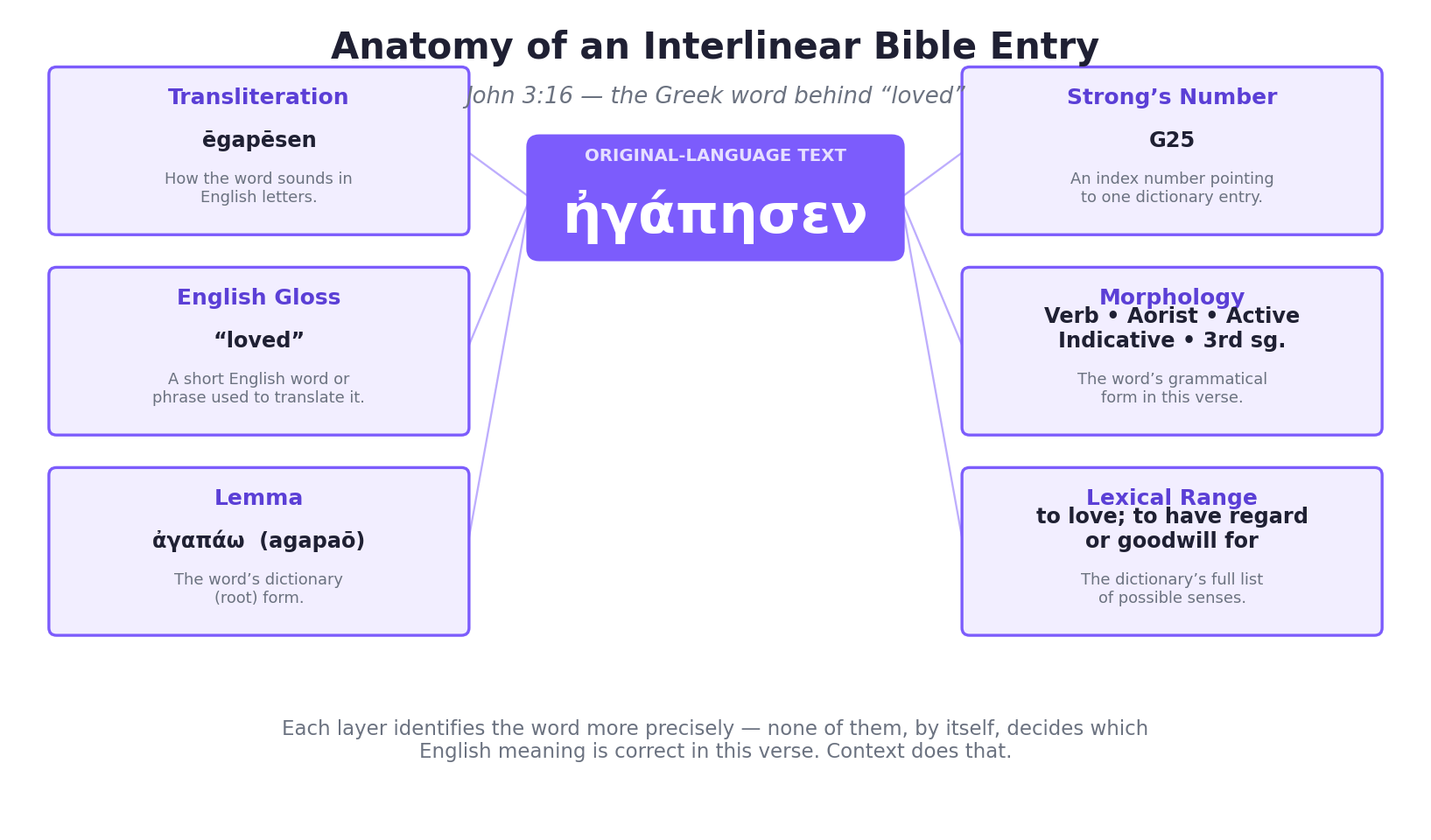
Every layer identifies the word more precisely — but none of them, by itself, decides which English meaning is correct in a specific verse.
What Languages Were the Bible Originally Written In?
Most of the Old Testament was written in Hebrew. A handful of passages were written in Aramaic: most notably parts of Daniel (2:4b–7:28) and Ezra (4:8–6:18; 7:12–26), plus one verse in Jeremiah (10:11) and two words in Genesis (31:47). Aramaic is a closely related language that became the everyday spoken language of much of the ancient Near East. The New Testament was written in Koine Greek, the common trade language of the eastern Mediterranean in the first century.
This is exactly why interlinears exist. English did not exist yet when Scripture was written, and every English Bible you have ever read is a translation from one of these three source languages.
How Does an Interlinear Bible Work?
The clearest way to understand an interlinear Bible is to walk through a real verse. Take John 3:16: "For God so loved the world, that he gave his only begotten Son…" (KJV).
It does not just place the Greek text next to this sentence. It maps each English word or phrase back to a specific Greek word, in the Greek text's own word order. That order is often not the same one the English translation uses.
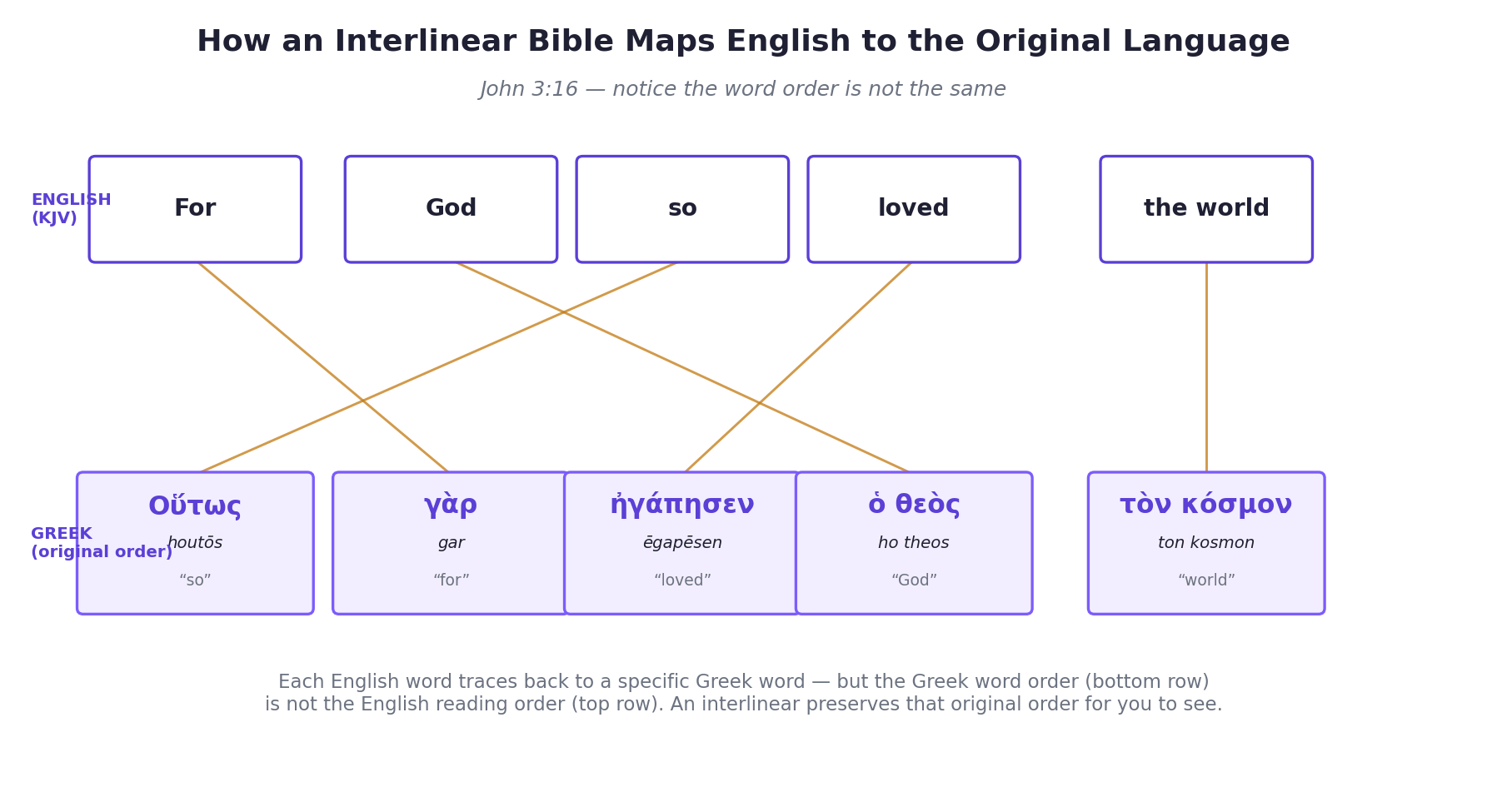
Each English word traces back to a specific Greek word — but the Greek word order isn't the English reading order. An interlinear preserves the original sequence so you can see it.
Once you can see which Greek word produced which English word, you have raw material for study. What you do with that material — checking a lexicon, examining the grammar, reading the surrounding context — is where responsible original language Bible study actually happens. The interlinear itself is the starting point, not the conclusion.
What Is Transliteration?
Transliteration represents the sound of a Hebrew or Greek word using familiar English letters, without translating its meaning. It is a pronunciation aid, not a definition.
For example, the Greek word ἠγάπησεν is transliterated ēgapēsen. Transliteration tells you how the word sounds; it says nothing about what the word means. That distinction matters, because it is easy to mistake a familiar-looking transliterated word for something you already understand in English, when the two may not overlap at all.
What Is a Lemma?
A lemma is a word's dictionary, or base, form — the form you would look up in a dictionary rather than every inflected variation you encounter in a sentence.
In English, "run," "runs," "ran," and "running" are all forms of the same lemma: "run." Hebrew and Greek work the same way, but with far more inflected forms per word. The Greek verb ἠγάπησεν ("he/she/it loved") is one of dozens of possible forms of the lemma ἀγαπάω (agapaō). Every lexicon entry, and every Strong's Number, is organized by lemma — so recognizing the lemma behind an inflected word is what actually lets you look it up.
What Are Strong’s Numbers?
Strong's Numbers are a reference system tied to the King James Version. It assigns one identifying number to each Hebrew or Aramaic word ("H" numbers) and each Greek word ("G" numbers). They come from the Exhaustive Concordance of the Bible, compiled by American theologian James Strong and first published in 1890 while he was a professor at Drew Theological Seminary. Strong's system covers 8,674 Hebrew and Aramaic entries, and its Greek numbers run up to 5,624.
A Strong's Number does one job: it identifies which original-language word you're looking at, consistently, across every Bible tool that uses the system. Strong's Numbers are identifiers, not definitions. G25 tells you that you're looking at the lemma ἀγαπάω; it does not, by itself, tell you which of that word's possible meanings applies in a given verse. Want a closer look at how these numbers connect to dictionary entries in practice? Our guide to the best Hebrew lexicon tools for Bible study walks through several sites that let you search by Strong's Number directly.
What Is a Bible Lexicon?
A Bible lexicon is a dictionary built specifically for biblical Hebrew, Aramaic, or Greek. Instead of an English headword, each entry starts from a lemma and lists that word's possible senses, its grammatical category, and often a sample of where it occurs in Scripture.
A lexicon differs from an interlinear in what it's for. An interlinear shows you which original word corresponds to a specific English word in a specific verse. A lexicon is a standalone reference you consult once you know which lemma you're researching. It does not, on its own, tell you which of its listed senses fits any particular verse. Our guide to the best Hebrew lexicon tools online compares several of the most widely used lexicons for readers doing this kind of research for the first time.
Interlinear Bible vs. Strong’s Concordance vs. Bible Lexicon
These four tools are often confused because they show up together in the same study Bibles and apps. Here is how they actually differ.
| Tool | Primary Purpose | What It Shows | Best Used For | Major Limitation |
|---|---|---|---|---|
| Interlinear Bible | Align a translation with its original-language source, word by word | The original word, its transliteration, and an English gloss, lined up together | Seeing exactly which original word produced a specific English word or phrase | Doesn't tell you which of a word's possible meanings applies here |
| Concordance | Index every occurrence of a word across the whole Bible | A list of every verse containing a given word (in English or the original language) | Finding everywhere else a word appears | Doesn't explain grammar or help you choose between possible meanings |
| Strong's Numbers | Identify one specific original-language word with a reference code | An "H" or "G" number tied to a single lemma | Cross-referencing a word consistently across different Bible tools and translations | An identifier, not a definition, by itself |
| Lexicon | Define what an original-language word can mean | The lemma, grammatical data, and the word's full range of possible senses | Looking up everything a word could mean in Scripture | Lists possibilities — it doesn't select which one fits a specific verse |
Traditional Interlinear vs. Reverse Interlinear Bible
Not every interlinear is laid out the same way. There are two common formats, and knowing the difference will save you real confusion the first time you open one.
A traditional interlinear starts with the original-language text, printed in its own word order, with English glosses placed underneath each word. This preserves the exact sequence the biblical author wrote in. But Hebrew and Greek word order often differs from English, so reading straight across the English glosses can produce an awkward, unnatural sentence.
A reverse interlinear is a format popularized by New Testament scholar Bill Mounce. It starts with the English translation in normal reading order and places the corresponding original-language word beneath each English word, reordered to match the English. This is generally easier for a first-time reader, since the English on top reads naturally. The trade-off is that the Hebrew or Greek underneath is no longer in its own original sequence.
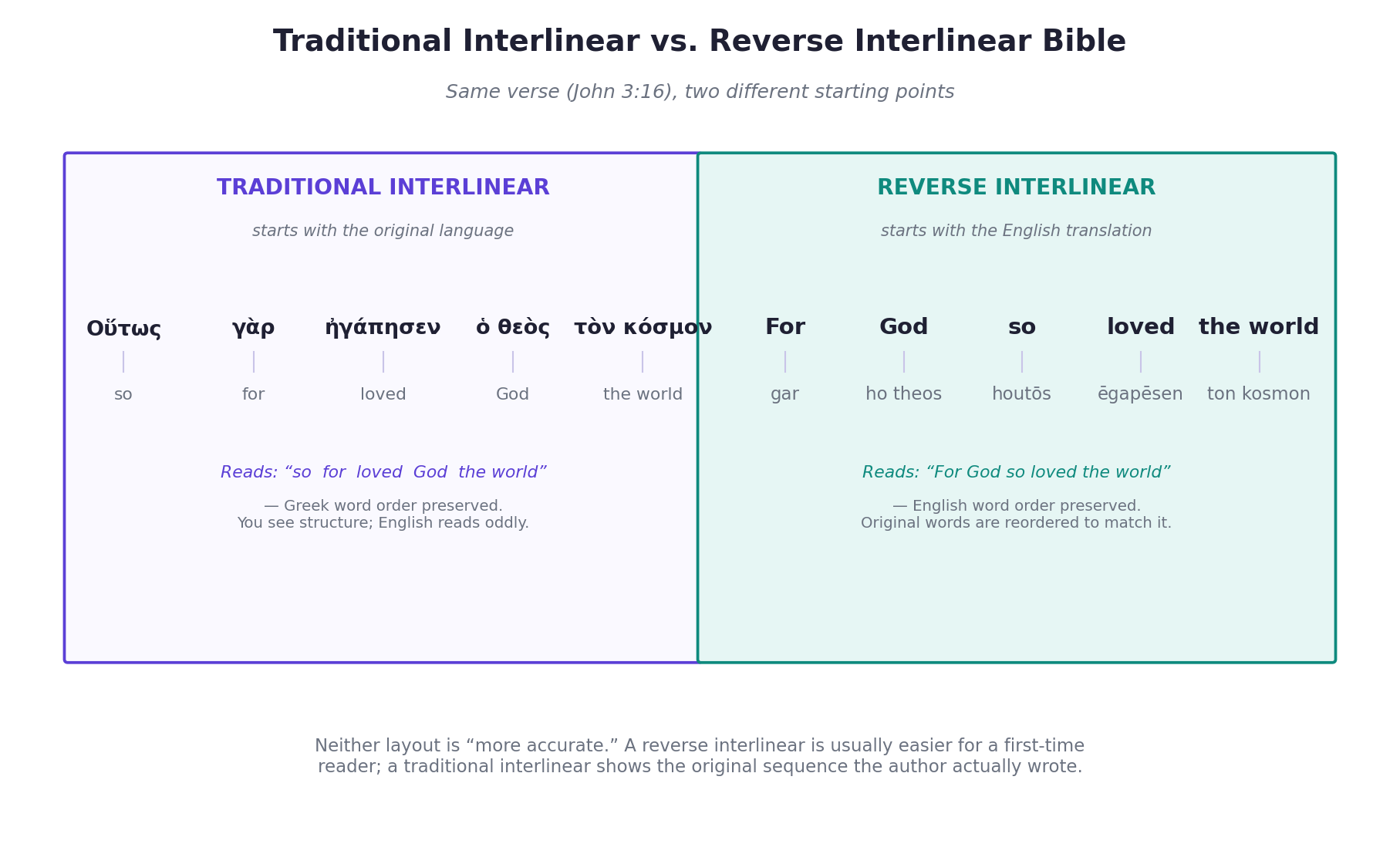
Neither format is more accurate than the other — they simply start from different ends of the same translation.
Neither format is more "correct." A reverse interlinear is usually the more comfortable entry point if this is your first time studying a Greek and Hebrew Bible side by side. A traditional interlinear is more useful once you want to see the original sentence structure itself.
Can You Study Hebrew and Greek Without Knowing Hebrew or Greek?
Yes — but the tools have to be used carefully.
Opening a Greek and Hebrew Bible interlinear for the first time can feel intimidating. But you do not need fluency in biblical Hebrew or Greek to gain real, legitimate insight from the original languages. An interlinear, a good lexicon, and some patience can meaningfully deepen how you read a passage. What you cannot do is skip the years of grammar training and expect to independently adjudicate disputed translation questions the way a trained scholar would. Original language Bible study for a non-specialist is about informed reading, not amateur translation. Used that way, it is one of the more rewarding habits a serious Bible reader can build.
What an Interlinear Bible Can Tell You
- Which specific Hebrew or Greek word corresponds to a given English word or phrase
- The word's transliteration, so you can recognize and pronounce it
- The word's lemma, or dictionary form
- The word's Strong's Number, for cross-referencing
- Basic grammatical (morphological) information, when the resource includes it
- The original word order, which sometimes differs meaningfully from the English translation
- Places where one original word corresponds to several English words, or several original words are compressed into one English word
What an Interlinear Bible Cannot Tell You by Itself
- Which of a word's several possible dictionary meanings actually applies in this verse
- Why a translator chose one specific English word over another equally valid option
- The finer points of Hebrew or Greek syntax and sentence structure
- Idioms, figures of speech, or cultural background the original audience would have simply known
- How a disputed textual or manuscript question should be resolved
- What the author intended, considered as a whole
An interlinear gives you evidence. It does not do the interpretive work for you.
The Biggest Mistake People Make With Interlinear Bibles
Here is the mistake, stated plainly: finding an interesting dictionary meaning for a word and assuming it must be present every time that word appears.
This has an actual name in biblical scholarship. Old Testament scholar James Barr called it "illegitimate totality transfer" in his 1961 book The Semantics of Biblical Language. It is the error of reading a word's entire range of dictionary meanings into one specific use of it, rather than letting context determine which single sense applies there.
An English analogy makes the danger obvious. The word "run" can mean jogging, operating a machine, a candidate seeking office, or a tear in a stocking. If someone tells you "I need to run to the store," you don't conclude that all four meanings are somehow present at once. Context immediately narrows it to one. Hebrew and Greek words work exactly the same way — a lexicon's full entry is a menu of possibilities, not a list of things the word means everywhere it occurs.
This is the difference between what a word can mean and what it means here. Learning to tell the two apart is arguably the single most valuable skill in original language Bible study.
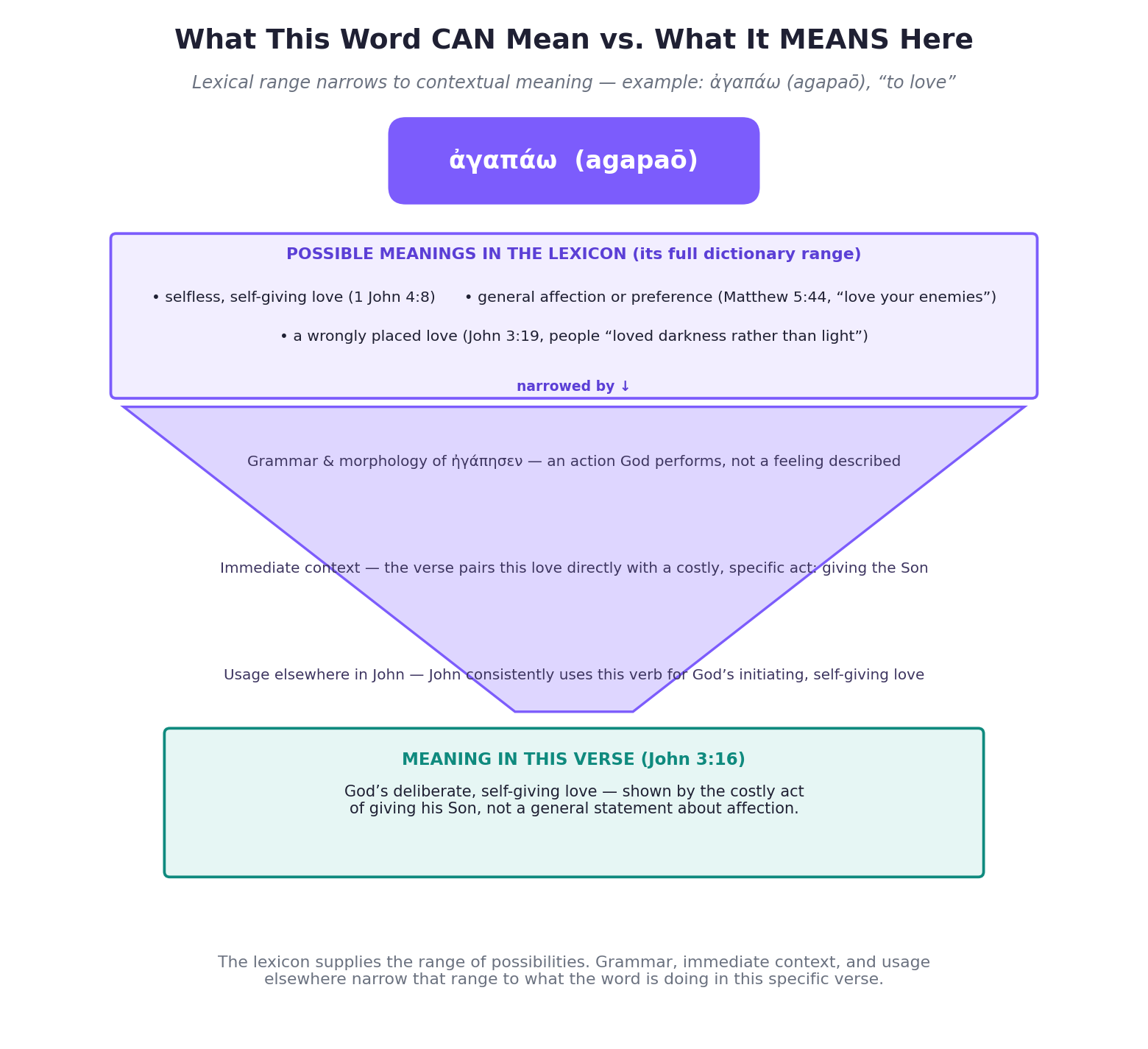
The lexicon supplies the range of possibilities. Grammar, context, and usage elsewhere narrow that range to what the word is actually doing in one specific verse.
A Real Example: Studying One Bible Verse With an Interlinear
Let's put this all together with John 3:16.
- English translation: "For God so loved the world, that he gave his only begotten Son…" (KJV)
- Relevant word: ἠγάπησεν (ēgapēsen), from the verb ἀγαπάω (agapaō)
- Strong's Number: G25
- Lexical range: Bible lexicons list a range of senses for agapaō, including selfless or self-giving love, general affection or preference, and simply "to have regard for." The word is even used elsewhere in this same chapter for people who "loved darkness rather than light" (John 3:19). That is obviously not a flattering use of the word.
- Grammatical evidence: The verb is aorist active indicative. God is the one doing the loving, and the aorist presents that love as a whole, past event. The tense alone does not make it an action rather than a feeling — John 3:19 uses the same tense for people who "loved darkness."
- Contextual evidence: The verse immediately pairs this love with a specific, costly action — giving his Son. The same verb appears in 1 John 4:10 for God's love that comes first: "not that we loved God, but that he loved us, and sent his Son" (KJV). Still, John's Gospel also uses a different verb, phileō, for the Father's love (John 16:27) — so the verb alone does not settle what kind of love is meant.
- What can legitimately be concluded: In this verse, agapaō describes a deliberate, self-giving love demonstrated by action — not a vague or purely emotional love.
- What should not be claimed: That the Greek word "really means" something dramatically different from "loved," or that English translators got this wrong. The English gloss "loved" is accurate. The interlinear and lexicon simply let you see what kind of love the word is describing here, based on grammar and context — not on the word alone.
That is what responsible original-language study looks like: using the evidence available, and stopping at the conclusions that evidence actually supports.
Want to see how context shapes the meaning of a verse you're studying? Open John 3:16 in ClearBible.ai — or any verse in the Bible reader — and tap Clear for a plain-English explanation of what the verse means in its context.
How Modern Bible Study Goes Beyond a Traditional Interlinear
Studying a Greek and Hebrew Bible used to mean flipping between a printed interlinear, a Strong's concordance, and a lexicon — three separate physical books. Digital tools can now combine original-language text, transliteration, Strong's data, morphology, lexicon entries, and cross-references in one place. That removes a lot of friction, but it does not remove the underlying interpretive work described above.
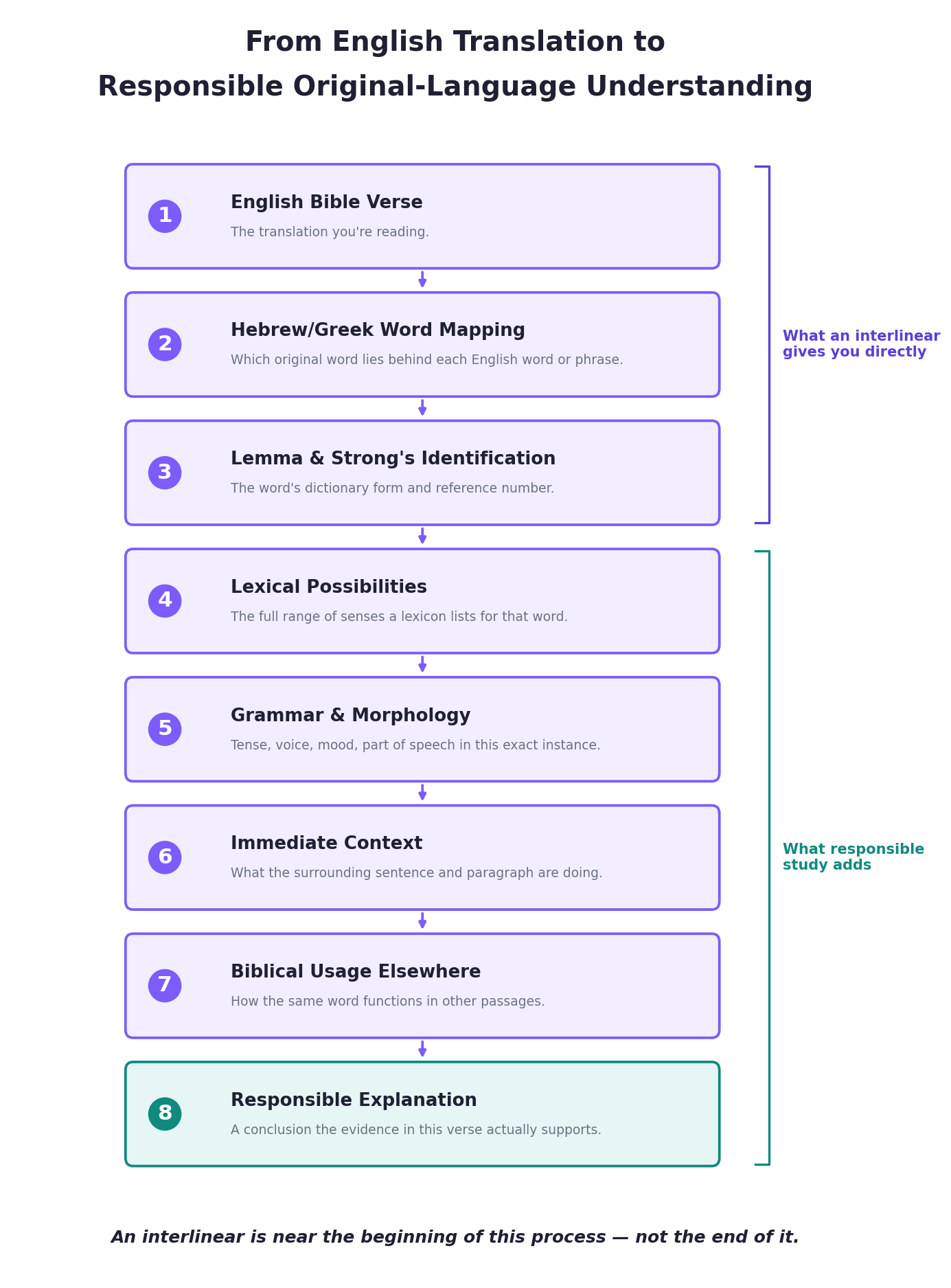
An interlinear is near the beginning of this process — not the end of it.
Combining these resources in one interface is a genuine convenience. It is not, by itself, a shortcut past grammar, context, and usage. The same evidence still has to be weighed the same way, whether you're using a 130-year-old printed concordance or an app on your phone.
How ClearBible.ai Approaches Original-Language Study
Most original-language tools — printed or digital — hand you raw data and leave you to sort out what matters. That's true of a traditional interlinear, and it's true of most lexicon and concordance apps. You get the transliteration, the Strong's Number, and a list of possible senses. The hardest step — deciding what actually applies to the verse in front of you — is still yours to do.
ClearBible.ai's Clear feature takes a different approach: instead of adding another layer of raw data to sort through, it starts from the verse in front of you. Tap any verse in the ClearBible.ai reader, and Clear reads it within its chapter. Then it explains in plain English what the verse means and the context you need to read it correctly. It also points out what is easy to miss and, when a verse is often misunderstood, the most common misreading. It brings up the Hebrew or Greek only when the original language genuinely changes how the verse should be understood. Even then, it explains that in everyday English, with no transliteration or word-study terms to decode.
This doesn't replace an interlinear, a lexicon, or a concordance. It follows the same rule this guide keeps returning to: context decides what a verse means, not an isolated dictionary definition. You can see this same discipline applied to a related word study in what "only begotten Son" (monogenēs) actually means in John 3:16. You can also read the plain-English explanation of John 3:16 in ClearBible.ai's Verse Explorer.
An interlinear Bible can show you the Hebrew or Greek behind a verse. ClearBible.ai can help you understand what that verse is actually saying — and you can start free, on any of the 31,102 verses in Scripture.
What an Interlinear Bible Can and Cannot Tell You
| Question | Answer |
|---|---|
| Identify the original word behind an English word? | Yes |
| Show a transliteration? | Yes |
| Show the word's dictionary (lemma) form? | Yes |
| Connect the word to a Strong's Number? | Yes |
| Show basic grammatical tagging, when included? | Yes |
| Tell you which dictionary sense fits this verse? | Not by itself |
| Fully explain the surrounding grammar and syntax? | Not by itself |
| Account for idiom, type of writing, or cultural background? | Not by itself |
| Resolve a disputed textual variant? | Not by itself |
| Determine the author's overall intent? | No, not by itself |
Frequently Asked Questions
What is an interlinear Bible?
An interlinear Bible displays the Bible's original Hebrew or Greek text together with a corresponding English translation, arranged word by word. It lets you see which original word produced each English word without needing to read Hebrew or Greek yourself.
What does “interlinear” mean in the Bible?
"Interlinear" describes the layout: the original-language text and its English equivalent are printed together, line by line or word by word, rather than as two separate, unconnected texts.
What is the difference between an interlinear Bible and a regular Bible?
A regular Bible gives you a finished English translation. An interlinear Bible additionally shows you the specific original-language word behind each part of that translation, so you can examine the underlying evidence yourself.
What is a reverse interlinear Bible?
A reverse interlinear Bible starts with the English translation in normal reading order. It places the corresponding Hebrew or Greek word beneath each English word, reordered to match the English rather than the original word order.
Can I understand biblical Greek or Hebrew without learning the language?
Yes, to a meaningful degree. Tools like interlinear Bibles and lexicons let you examine real evidence about a word's form and range of meaning. What they cannot replace is years of grammatical training for resolving genuinely disputed questions.
What are Strong’s Numbers?
Strong's Numbers are reference codes — "H" for Hebrew and Aramaic, "G" for Greek — that identify one specific original-language word, based on James Strong's 1890 Exhaustive Concordance of the Bible. They identify a word; they do not define it.
Is an interlinear Bible the same as a lexicon?
No. An interlinear Bible aligns a translation with its original-language source in a specific verse. A lexicon is a standalone dictionary of Hebrew, Aramaic, or Greek words that you consult separately once you know which word you're researching.
Can an interlinear Bible tell me the exact meaning of a Hebrew or Greek word?
Not by itself. An interlinear identifies the word and may show its grammatical form. But choosing which of that word's possible meanings fits a specific verse requires looking at grammar, immediate context, and how the word is used elsewhere in Scripture.
Which language was the Old Testament written in?
Primarily Hebrew, with small portions in Aramaic (notably parts of Daniel and Ezra).
Which language was the New Testament written in?
Koine Greek, the common trade language of the eastern Mediterranean in the first century.
Are interlinear Bibles accurate?
The original-language text, transliteration, and Strong's data in a reputable interlinear Bible are accurate representations of the source text and standard reference tools. Accuracy in the conclusions a reader draws from that data still depends on how carefully grammar, context, and usage are weighed — the interlinear itself doesn't make that judgment for you.
Sources and Further Reading
- James Strong, The Exhaustive Concordance of the Bible (1890) — the origin of Strong's Numbers
- James Barr, The Semantics of Biblical Language (Oxford University Press, 1961) — the classic critique of "illegitimate totality transfer" and related word-study fallacies
- Blue Letter Bible: Greek Interlinear for John 3:16
- Blue Letter Bible: Strong's G25 (ἀγαπάω)
- Logos Bible Software: Understanding Traditional and Reverse Interlinears
- Olive Tree Bible Software: Look Inside a Reverse Interlinear
- Wikipedia: Strong's Concordance
- Tony Payne, "The Blunder in Our Bible Reading" — a plain-English explanation of illegitimate totality transfer
This is an informational, educational overview and does not constitute theological or doctrinal instruction. Where scholars genuinely disagree on a translation or interpretive question, that disagreement is noted rather than resolved for you.
Keep Studying
Go deeper on this verse — or your own. Everything above comes down to one habit: letting context decide what a verse means. That habit is what ClearBible.ai's Clear feature is built on. Create a free account to try Clear on any of the 31,102 verses in Scripture — no credit card required to start reading.
Share this guide. If this made original language Bible study feel less intimidating, pass it along. Share it with a friend, a small group, or anyone else opening a Greek and Hebrew Bible for the first time. Understanding this material well enough to explain it to someone else is one of the best ways to retain it.
Tell us what you're studying. Have a question about a specific word or verse, or a passage where an interlinear left you more confused than when you started? Email us at support@clearbible.ai — we read every one, and reader questions regularly shape which word studies we write next.
An interlinear Bible is one of the most useful doors into original language Bible study that an ordinary reader has access to. It turns a translation into something you can actually examine, word by word, rather than simply take on faith. Use it carefully, alongside a lexicon, real attention to grammar, and a refusal to read every dictionary meaning into a single verse. Then an interlinear Bible can turn a familiar passage into something you understand at a genuinely deeper level — without ever requiring you to become fluent in Hebrew or Greek yourself.
Look up any verse in plain modern English.
Open the Verse Explorer →Daily Verse — straight to your inbox
A verse and a 2-sentence plain-English explanation, every morning. Free. Unsubscribe anytime.