Jump to section
- What Is Strong’s Concordance?
- Who Was James Strong?
- Why Was Strong’s Concordance Created?
- What Is a Strong’s Number?
- Chart 1 — Hebrew Numbers vs. Greek Numbers
- What Is Strong’s Lexicon?
- Strong’s Concordance vs. Strong’s Lexicon
- Chart 2 — Concordance vs. Lexicon at a Glance
- How Strong’s Numbers Work: A Real Example, Step by Step
- What Strong’s Concordance Can Tell You
- What Strong’s Concordance Cannot Tell You
- Chart 3 — What Strong’s Can and Cannot Do on Its Own
- The Biggest Mistake People Make With Strong’s Numbers
- The Responsible Word-Study Workflow
- How Modern Bible Study Uses Strong’s Numbers
- How ClearBible.ai Uses Original-Language Evidence
- Frequently Asked Questions
- What is Strong’s Concordance used for?
- Is Strong’s Concordance a lexicon?
- What does H mean in Strong’s numbers?
- What does G mean in Strong’s numbers?
- Are Strong’s Numbers definitions?
- Can Strong’s Concordance tell me the original Hebrew or Greek?
- Is Strong’s Concordance accurate?
Strong’s Concordance is the reason an ordinary Bible reader — with no Hebrew or Greek training at all — can look at an English verse and find the original-language word standing behind it. First published in 1890 by the American biblical scholar James Strong, it is an index of every word in the King James Version, paired with numbered dictionaries of the Hebrew and Greek words those English words came from.
That numbering system quietly changed Bible study. It is why almost every Bible app, interlinear, and free lexicon website today shows you a little code like H2617 or G2889 next to a word.
This guide explains exactly what the concordance is, what those numbers do, what a lexicon is, and — most importantly — the one thing Strong’s Numbers can never tell you.
What Is Strong’s Concordance?
Strong’s Concordance is an exhaustive index of every word in the King James Version of the Bible, published in 1890 under the direction of James Strong. Beside each English word it lists every verse where that word appears, along with a number pointing to the underlying Hebrew or Greek word in a dictionary at the back of the volume.
Two things are bundled into one book:
- The concordance itself — an alphabetical index of KJV English words and where they occur.
- Two numbered dictionaries — a Hebrew (and Aramaic) dictionary for the Old Testament and a Greek dictionary for the New Testament.
The number is the bridge between them. Look up an English word, find your verse, read the number, then flip to the dictionary and find the original word. The full title page of the 1890 edition says so plainly: it promises every word of the common English version, every occurrence of each word, and brief dictionaries of the Hebrew and Greek words of the original (1890 first edition, Internet Archive).
Because it was published in 1890, the original work is in the public domain. That is why Strong’s data is free on so many websites and inside so many apps — no licensing required.
Who Was James Strong?

Studio portrait identified as Prof. James Strong, taken between 1855 and 1865 — decades before the concordance was published. Brady-Handy photograph collection, Library of Congress (LC-DIG-cwpbh-01298).
James Strong (1822–1894) was an American Methodist biblical scholar and lexicographer. He graduated from Wesleyan University in 1844 and served as Professor of Exegetical Theology at Drew Theological Seminary in New Jersey for twenty-five years, from 1868 to 1893.
Strong was not a hobbyist. He was also supervising editor of the ten-volume Cyclopædia of Biblical, Theological and Ecclesiastical Literature (commonly called McClintock and Strong), and he served on the American committee behind the Revised Version of the Bible, the project that produced the American Standard Version of 1901. The concordance carrying his name was the work of a career scholar and a team, compiled by hand in an era before computers.
Why Was Strong’s Concordance Created?
Strong’s Concordance was created to solve two problems at once: finding a verse, and seeing behind the translation.
Before searchable text, finding a half-remembered phrase meant hunting through 1,189 chapters. An exhaustive index fixed that.
The numbering was the more ambitious part. English translations must pick one word where the original used several, and reuse one English word for several different originals. Strong’s system let a reader see through the translation and ask, "Is this the same Hebrew word as that one?" — without knowing Hebrew.
Strong himself was modest about the dictionaries. He called them brief dictionaries on the title page and noted in his prefaces that they were not meant to replace a fuller, more elaborate lexicon. That modesty is the single most-ignored sentence in the whole project, and most of this article exists to take it seriously.
What Is a Strong’s Number?
A Strong’s number is an identifier assigned to a Hebrew or Greek dictionary entry in Strong’s Concordance. "H" marks a Hebrew or Aramaic word from the Old Testament; "G" marks a Greek word from the New Testament. The number tells you which word stands behind the English — it is not a definition.
The original concordance contains:
- 8,674 Hebrew (and Aramaic) entries for the Old Testament — numbered 1 to 8674
- 5,624 Greek numbers for the New Testament — though roughly 5,523 are actually used, because number 2717 and the block 3203–3302 were dropped when the enumeration was revised during production, as a note at the end of Strong’s Greek dictionary explains
One detail almost nobody mentions: the H and G prefixes are not Strong’s. In the printed book, the Hebrew and Greek dictionaries were numbered separately, so "25" was ambiguous — Hebrew 25 and Greek 25 are different words. Digital tools added the H/G prefix so a single code could be unmistakable. When you see G25 in a Bible app, you are reading a modern convention built on Strong’s original scheme.
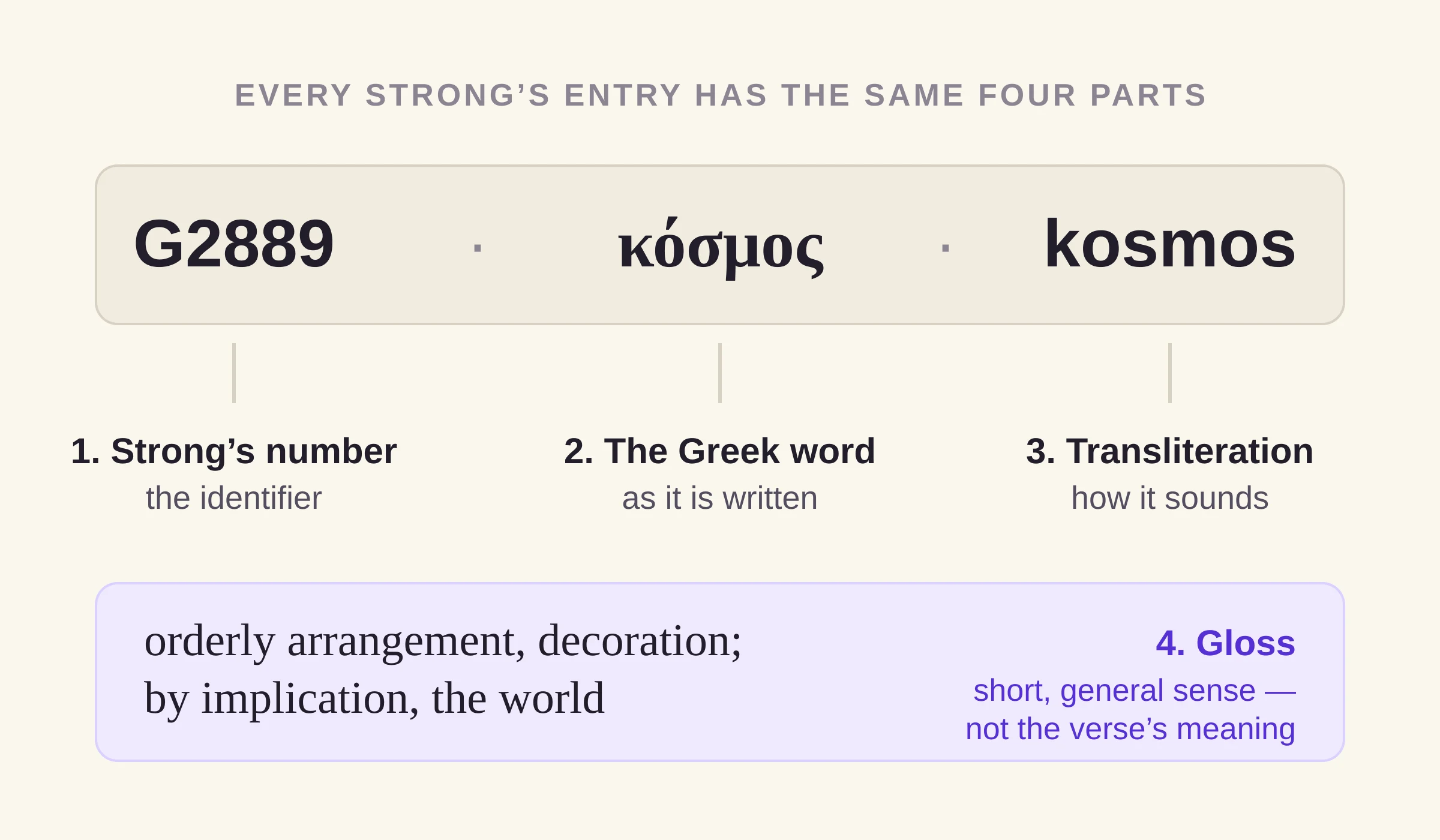
Every Strong’s entry has the same four parts: the number, the original word, a transliteration, and a short gloss.
Chart 1 — Hebrew Numbers vs. Greek Numbers
| H-numbers | G-numbers | |
|---|---|---|
| Language | Hebrew (and some Aramaic) | Koine Greek |
| Testament | Old Testament | New Testament |
| Range | H1 – H8674 | G1 – G5624 |
| Example | H2617 — chesed (KJV: mercy, kindness, lovingkindness…) | G2889 — kosmos (KJV: world, adorning) |
| What it does | Identifies the dictionary entry behind the English word | Identifies the dictionary entry behind the English word |
Note the last row. It is identical on purpose. Hebrew and Greek numbers do exactly the same job: they point.
What Is Strong’s Lexicon?
"Strong’s Lexicon" is the common name for the two dictionaries printed at the back of Strong’s Concordance — the Hebrew and Aramaic dictionary and the Greek dictionary — usually as presented today on websites and in Bible apps. Each entry gives a transliteration, a pronunciation guide, a note on the word’s derivation, and a short list of the English words the KJV used to translate it.
Strictly speaking, James Strong never published a standalone book called "Strong’s Lexicon." The phrase grew up around the digital versions. When a site labels a page Strong’s Greek Lexicon, it means the dictionary portion of the concordance, displayed on its own.
That matters for expectations. Its entries are short by design — a gloss, not an argument. Full scholarly lexicons such as BDB and HALOT for Hebrew, or BDAG and Louw–Nida for Greek, run to paragraphs per word, sorting meanings by sense and citing where each sense occurs. If you want to know which sense fits your verse, that is the kind of resource that answers it. Our guide to the best Hebrew lexicons available online compares those tools directly.
Strong’s Concordance vs. Strong’s Lexicon
A concordance answers "where does this word appear?" A lexicon answers "what can this word mean?" Strong’s Concordance contains both: the index is the concordance, and the numbered dictionaries in the back are what people now call Strong’s Lexicon.
Chart 2 — Concordance vs. Lexicon at a Glance
| Strong’s Concordance (the index) | Strong’s Lexicon (the dictionaries) | |
|---|---|---|
| Purpose | Locate words and occurrences | Identify and gloss original words |
| Contains | Every KJV word, every verse, plus a number | Numbered Hebrew/Greek entries with short definitions |
| Answers | "Where else does this word appear?" | "What Hebrew or Greek word is this, and what does it broadly mean?" |
| Main limit | Indexes English words, not original grammar | Very brief; no grammar, no sense-by-verse guidance |
| Example use | Find all 241 Old Testament verses containing chesed | Read what chesed can mean |
A useful way to hold it: the concordance is a map, the lexicon is a glossary, and neither one is the journey.
How Strong’s Numbers Work: A Real Example, Step by Step
Take the most-loved verse in the Psalms.
Psalm 23:6 (KJV) — "Surely goodness and mercy shall follow me all the days of my life."
Step 1 — Start with the English word. You notice that other translations do not say "mercy." They say steadfast love, or unfailing love, or faithful love. Why?
Step 2 — Find the Strong’s number. In any Strong’s-linked Bible, "mercy" here is tagged H2617.
Step 3 — Identify the original word. H2617 is חֶסֶד — chesed (pronounced roughly KHEH-sed).
Step 4 — Read the lexical information. Strong’s glosses it as kindness, and, toward God, piety. Blue Letter Bible’s tally of the KJV shows how the translators handled it: mercy 149 times, kindness 40, lovingkindness 30, goodness 12, and a scattering of others including, once, "reproach" (Blue Letter Bible, H2617).
Step 5 — Check the grammar and the context. Chesed is a noun here, paired with "goodness," in a psalm about God’s covenant care for a shepherded people. The setting favours loyal, committed kindness — which is exactly why modern translations reach for "steadfast love."
Step 6 — Draw a careful conclusion. The Strong’s number did not tell you the verse means "steadfast love." It told you which Hebrew word to examine, and it explained why translations differ. That is a real, honest payoff — and it is exactly what the system was built to deliver.
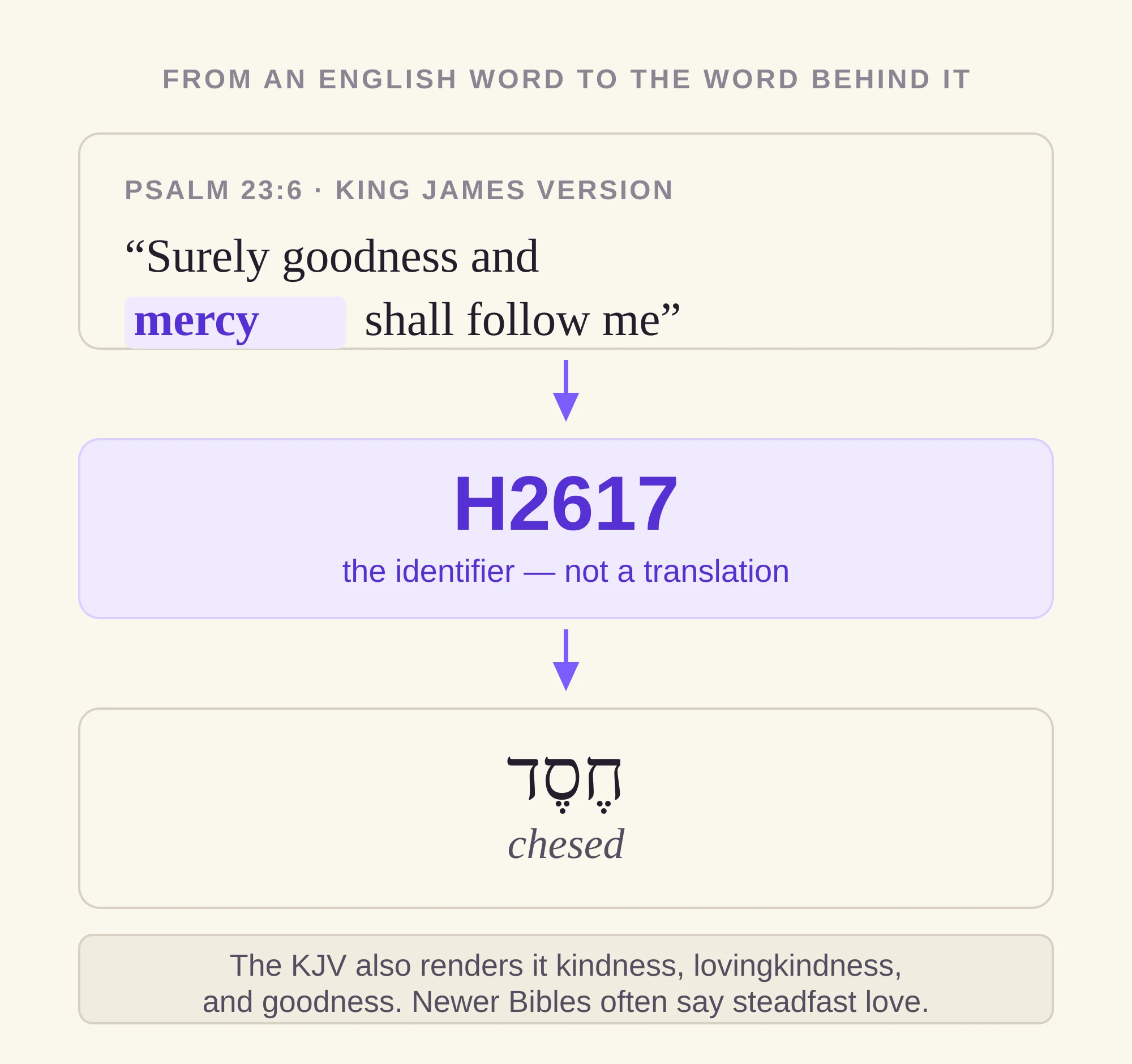
A Strong’s number is a bridge between an English word and the original word behind it — not a translation of the verse.
What Strong’s Concordance Can Tell You
Used properly, the concordance can reliably tell you:
- Which original word lies behind an English word in the KJV.
- Where else that same original word appears in the Bible.
- Whether two English words come from the same original word — or whether one English word is covering several different originals.
- How the KJV translators handled a word across the whole Bible, which often explains why versions disagree.
- A short, general sense of the word’s meaning.
That is a genuinely valuable set of answers, and it is available free to anyone with a phone.
What Strong’s Concordance Cannot Tell You
Strong’s Concordance cannot tell you which meaning is active in your verse, and it was never designed to.
It also cannot tell you:
- The grammar. Tense, mood, voice, person, number, and case are carried by the form of the word in the text. The numbers point to root or dictionary forms, so one number covers many different forms. Strong’s alone will not tell you whether a command, a completed action, or an ongoing one is in view.
- The syntax. How the word relates to the words around it — the actual sentence — is outside its scope.
- The literary or historical context. Who is speaking, to whom, and why.
- Which sense the author intended. This is the big one, and it gets its own section below.
Chart 3 — What Strong’s Can and Cannot Do on Its Own
| Task | Strong’s alone? | What you actually need |
|---|---|---|
| Identify the underlying Hebrew or Greek word | ✅ Yes | — |
| Find every occurrence of that word | ✅ Yes | — |
| Show a short, general gloss | ✅ Yes | — |
| Explain why translations differ | ⚠️ Partly | Plus a fuller lexicon |
| Determine tense, mood, or case | ❌ No | Morphology / parsing data |
| Decide which sense fits this verse | ❌ No | Context, syntax, usage |
| Prove every dictionary meaning applies | ❌ Never | This is a known error — see below |
The Biggest Mistake People Make With Strong’s Numbers
Strong’s Numbers are identifiers, not definitions. A number identifies a dictionary entry; it does not prove that every meaning listed in that entry is present in the verse you are reading.
Here is the clearest way to see it.
The Greek word kosmos is G2889. Strong’s entry begins with "orderly arrangement" and "decoration," then moves to "the world." Two very different ideas, one number.
Now look at how the KJV actually uses it. Of the 187 times G2889 appears, the KJV renders it "world" 186 times and "adorning" once (Blue Letter Bible, G2889). That single exception is 1 Peter 3:3, where Peter is talking about hair, gold, and clothing.
So:
- In John 3:16, G2889 means humanity — the world God loved.
- In 1 Peter 3:3, the same G2889 means outward decoration.
The number is identical in both verses. The meaning is not. Only the sentence decides.
The mistake happens when a reader takes the whole list of possible meanings and pours them into one verse — preaching, for instance, that "God so loved the ornament" because "adorning" appears in the entry. Linguists have a name for this: illegitimate totality transfer, a term coined by the Hebrew scholar James Barr in The Semantics of Biblical Language (Oxford University Press, 1961). Its cousin is the etymological fallacy — assuming a word’s origin is its real meaning, so that dynamis must mean explosive power because "dynamite" came from it centuries later (Robert Cara, "Word-Study Fallacies," Ligonier Ministries).
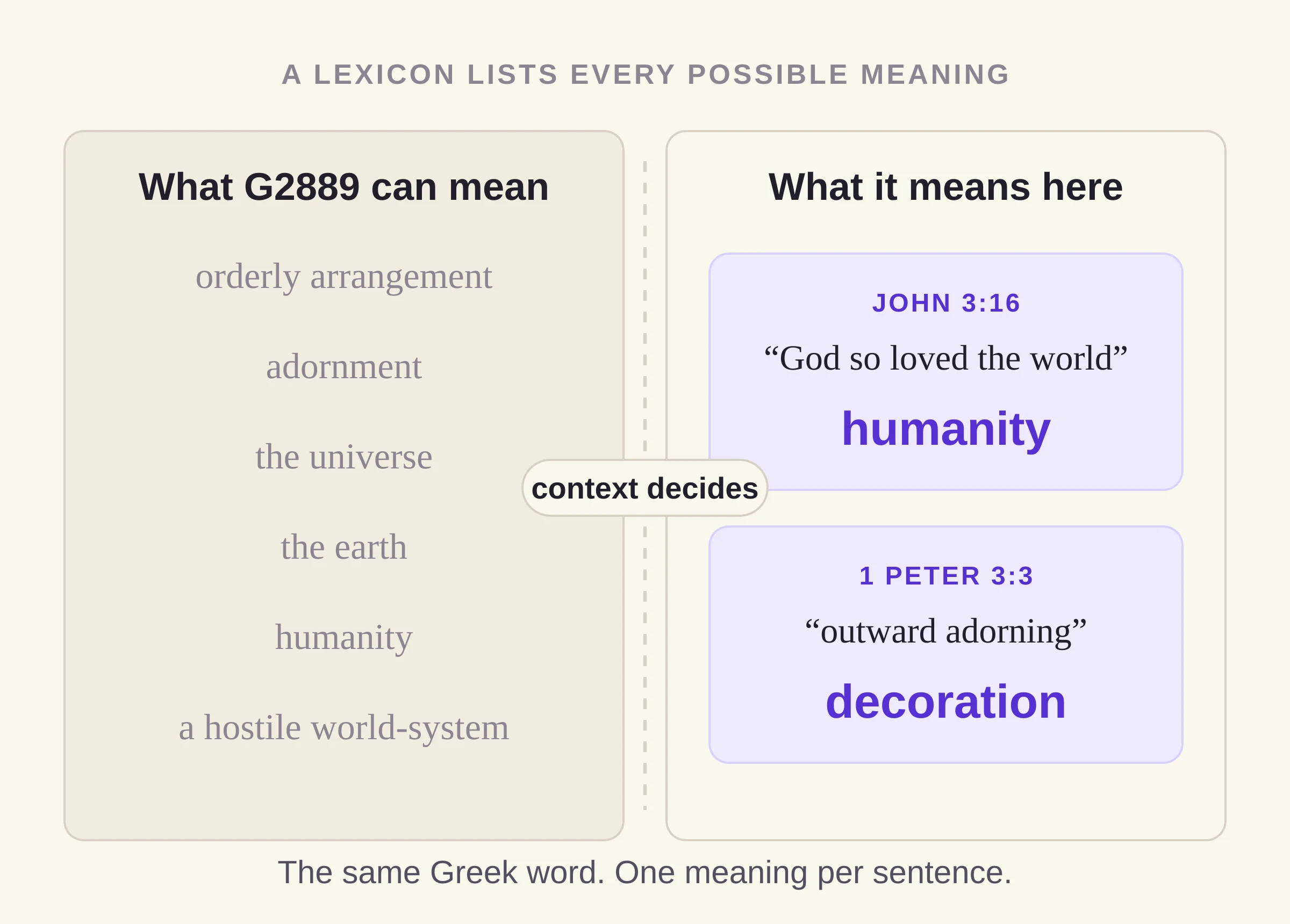
A lexicon shows every meaning a word could carry. The sentence decides which one it does carry.
The simple rule: a Strong’s number tells you what a word can mean somewhere. Only the verse tells you what it does mean here.
The Responsible Word-Study Workflow
A Strong’s number is one step in a chain, not the whole chain. Skipping the last two steps is where word studies go wrong.
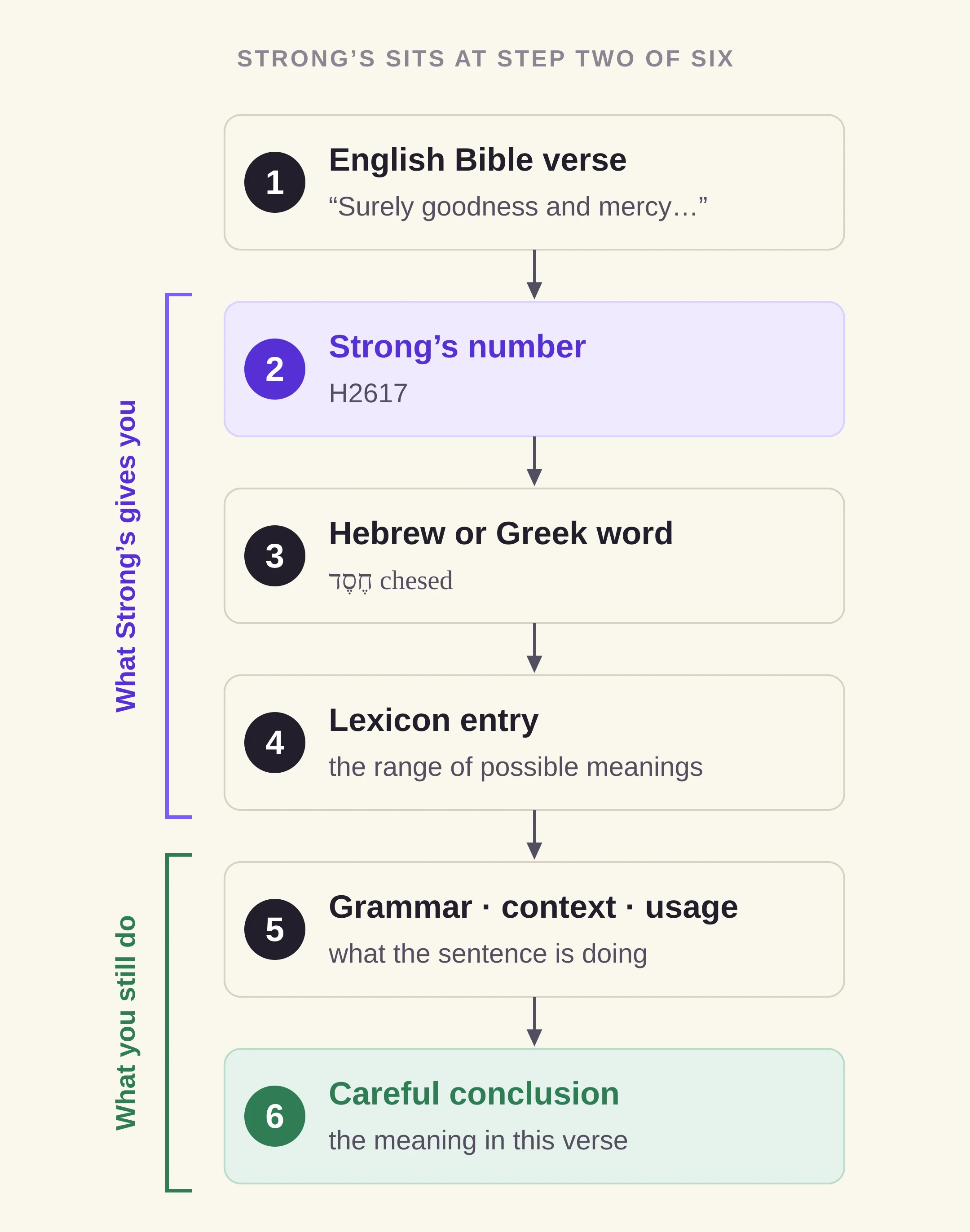
Strong’s sits at step two of six. The final decision about meaning is always made by grammar, context, and usage.
How Modern Bible Study Uses Strong’s Numbers
Strong’s numbering survived into the digital age because it turned out to be an excellent database key. Tag every word in the biblical text with a number, and a computer can do in a second what once took an afternoon.
The numbering now sits underneath:
- Digital concordances — tap a word, see every occurrence instantly.
- Interlinear Bibles, which stack the original word, its number, and an English gloss under each other.
- Online lexicons, which use the number as the address of an entry.
- Morphology tags, which supply the grammar Strong’s leaves out — a separate layer of data, usually shown alongside the number.
- Translation-comparison tools, which line up how different versions rendered the same numbered word.
Two cautions are worth knowing. First, Strong’s dictionaries reflect 19th-century scholarship; Strong drew on lexicographers such as Gesenius and Fürst, and lexicography has advanced considerably since. Second, an alternative numbering system — Goodrick–Kohlenberger — is used in some modern resources, so numbers from one system do not match the other.
If you want the wider landscape of what is available, see our review of the best Bible study tools online and our worked example of a New Testament word study in the Greek word for glory.
How ClearBible.ai Uses Original-Language Evidence
ClearBible.ai did not invent Strong’s numbering and does not pretend to replace a scholarly lexicon. It handles the step where most readers get stuck.
Behind the app sits original-language data for the whole Bible — a Strong’s-style identifier table plus compressed Hebrew and Greek lexicon files. Today that data powers the Study tool in Sermon Builder. Study picks out a few words that carry a passage and gives each one a short, plain-English note. Clear does not use this data. Neither tool dumps a list of dictionary definitions on a reader. That is the exact habit that produces the mistake described above.
When you open a verse in ClearBible.ai and tap Clear, it reads the verse within its chapter. You get the plain meaning of the verse, the context around it, what is easy to miss, and where readers commonly go wrong. It brings in original-language detail only where it genuinely changes what the verse is saying, and then in everyday English. Clear is built to leave out anything it can’t support, rather than make up a hidden meaning.
That same discipline governs the Clear Bible Translation’s multi-stage accuracy review, where high-impact wording is checked against Hebrew and Greek references before publication.
Now that you know what Strong’s Numbers can — and cannot — tell you, put it to work on a verse. Open any chapter in the ClearBible.ai Bible reader and tap Clear, or browse plain-English explanations for all 31,102 verses in the Verse Explorer.
Frequently Asked Questions
What is Strong’s Concordance used for?
Strong’s Concordance is used to find every verse where an English KJV word appears and to identify the Hebrew or Greek word behind it. Readers use it to locate passages, compare how one original word was translated in different places, and begin word studies without knowing the original languages.
Is Strong’s Concordance a lexicon?
Not exactly. Strong’s Concordance is an index that contains two small dictionaries. The index is the concordance; the dictionaries at the back are what people now call Strong’s Lexicon. Both are printed in the same volume, which is why the terms get mixed up.
What does H mean in Strong’s numbers?
"H" means the entry is from Strong’s Hebrew and Aramaic dictionary, covering the Old Testament. H2617, for example, is chesed. The prefix is a modern digital convention added to prevent confusion with Greek numbers, which are numbered separately.
What does G mean in Strong’s numbers?
"G" means the entry is from Strong’s Greek dictionary, covering the New Testament. G2889, for example, is kosmos. Greek numbers run from 1 to 5624, with a block of unused numbers left over from a revision during the original production.
Are Strong’s Numbers definitions?
No. Strong’s Numbers are identifiers. A number tells you which Hebrew or Greek dictionary entry stands behind an English word. It does not tell you which of that entry’s possible meanings the author intended in a specific verse — grammar, syntax, and context determine that.
Can Strong’s Concordance tell me the original Hebrew or Greek?
It can tell you the dictionary form of the original word, which is often enough to answer why translations differ. It generally will not tell you the exact grammatical form used in the verse, because the numbers point to root or lexical entries rather than to parsed forms.
Is Strong’s Concordance accurate?
The index is famously thorough, and the numbering is reliable for identifying words. The dictionaries, however, are brief by design and reflect 19th-century lexicography. For questions of nuance, current scholarly lexicons such as HALOT, BDB, BDAG, or Louw–Nida are more dependable.
How do I use Strong’s Concordance online?
Open a verse in a Strong’s-linked Bible, tap or click the word you are curious about, read the number and the original word, then check where else that word appears and how the surrounding sentence uses it. Free Strong’s data is widely available because the 1890 edition is in the public domain. For a plain-English route through the same question, see our guide to what a Bible verse means, in five steps.
Conclusion
Strong’s Concordance remains one of the most useful Bible-study tools ever made, and after more than 130 years it still quietly powers the word-study features in nearly every Bible app. It hands an ordinary reader something that used to require years of training: the ability to see which Hebrew or Greek word sits behind an English one, and where else that word appears.
What it hands you is evidence, not a verdict. Strong’s Numbers identify; lexicons list possibilities; grammar, syntax, and context decide. Readers who remember that distinction get real insight out of Strong’s Lexicon data. Readers who forget it end up confidently teaching things the verse never said.
Use it for what it is, and it will serve you well. Strong’s Concordance opens the door to the original languages — the verse in front of you is what tells you which room you have walked into.
Sources and Further Reading
- Strong, James. The Exhaustive Concordance of the Bible. New York: Hunt & Eaton, 1890. Full scan of the first edition — Internet Archive.
- Blue Letter Bible, Strong’s Hebrew Lexicon H2617 — chesed.
- Blue Letter Bible, Strong’s Greek Lexicon G2889 — kosmos.
- Cara, Robert. "Word-Study Fallacies." Tabletalk / Ligonier Ministries.
- Barr, James. The Semantics of Biblical Language. Oxford: Oxford University Press, 1961. The study that named "illegitimate totality transfer."
- Prof. James Strong [photograph, between 1855 and 1865]. Brady-Handy photograph collection, Library of Congress Prints and Photographs Division, LC-DIG-cwpbh-01298. No known restrictions on publication.
- Strong, James, and John McClintock. Cyclopædia of Biblical, Theological, and Ecclesiastical Literature, 10 vols., 1867–1881. See works by James Strong at the Internet Archive.
- Drew University Library, University Archives. "James Strong Papers." Records Strong as Professor of Exegetical Theology at Drew Theological Seminary from 1868 to 1893.
ClearBible.ai is an educational reading tool. It does not provide spiritual counseling, religious advice, or interpretive theology.
Look up any verse in plain modern English.
Open the Verse Explorer →Daily Verse — straight to your inbox
A verse and a 2-sentence plain-English explanation, every morning. Free. Unsubscribe anytime.