Old Testament
2 Chronicles 3:7
Read the Bible in clear, modern English—easy to understand, faithful to the meaning, and written for everyday readers.
He covered the entire house with gold—the beams, the posts, the walls, and the doors—and carved cherubim into the walls.
Compare translations
He overlaid also the house, the beams, the posts, and the walls thereof, and the doors thereof, with gold; and graved cherubims on the walls.
What 2 Chronicles 3:7 means
Plain-English insight for readers
In this passage, we see a grand display of beauty and reverence as the entire temple is covered in gold. Every part of the structure, from the beams to the walls, is adorned with this precious metal, symbolizing purity and value. The intricate carvings of cherubim, angelic beings, add a layer of spiritual significance to the space. This lavish decoration reflects the importance of the temple as a place of worship and connection with the divine. The gold represents not just wealth, but also the glory of God, making the temple a fitting home for His presence. The attention to detail in the craftsmanship shows a deep respect for the sacredness of the space. This scene invites us to consider how we honor the places and moments in our lives that are significant to us. Just as the temple was made beautiful for God, we can create beauty in our own lives through our actions and intentions, making our surroundings reflect our values and beliefs in meaningful ways. It’s a reminder to cherish what is sacred.
How to apply 2 Chronicles 3:7 to your life
Consider how you can create beauty in your own life. This might mean taking care of your surroundings or investing time in meaningful relationships. Reflect on what is sacred to you and how you can honor it. Small acts of care can transform ordinary spaces into something special. Make your life a reflection of your values and beliefs in tangible ways.
Curated for this public verse page. 2 Chronicles Summary
Learn the Bible through its people and places
Get to know the people in Scripture through illustrated stories, and explore the places where they lived and traveled.
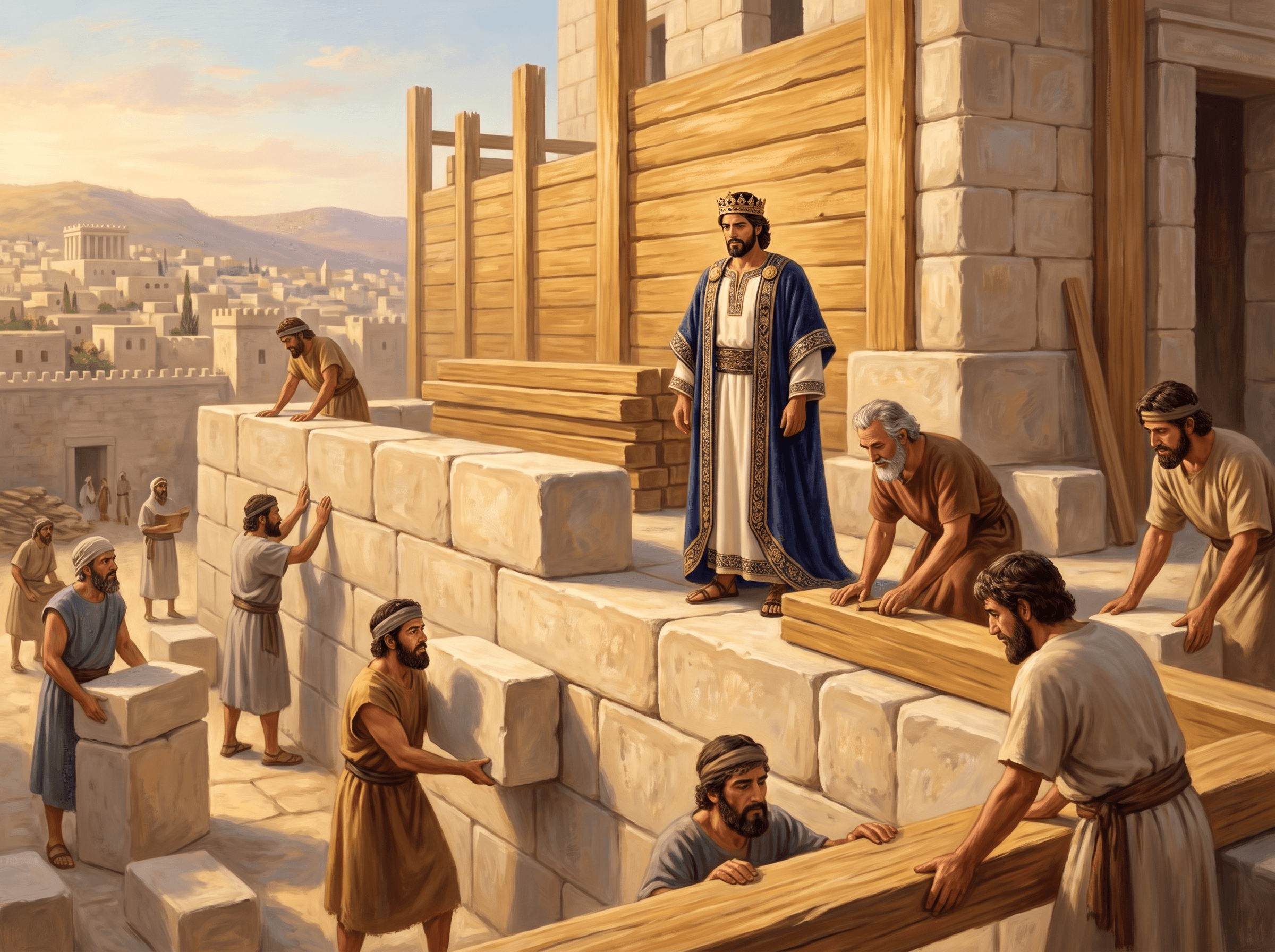
Illustrated scene from Solomon's story: Building the Temple (2 Chronicles 3:1–17)
Meet the people of the Bible
Follow their lives in order, with illustrated scenes and Bible passages that tell their stories.
 Solomon

Photo: Photochrom print, Library of Congress Prints and Photographs Division (LCCN 2002724987). License: Public domain in the United States; Library of Congress states no known restrictions on publication. Source. Location: Hebron, West Bank; print preserved by the Library of Congress. Resized for the web.
Explore the places of the Bible
See where biblical events happened, why each place matters, and what archaeology helps us understand.
Hebron
Where Abraham lived and buried Sarah, and where David was first made king.
Get full access with one subscription
Explore the people and places of the Bible. Read summaries of every book, with images and clear explanations covering every chapter. Access all these features and our Bible study tools with one subscription.
See PlansAsk AI about 2 Chronicles 3:7
Ask a question about this verse and get a clear answer, with Bible references you can read for yourself.
Every Bible book, explained chapter by chapter
Explore summaries of every book of the Bible, with images and easy-to-understand explanations covering every chapter.
Keep studying 2 Chronicles 3:7
Related Bible verses
Key themes
Related topics
At a Glance — the Book of 2 Chronicles
- Author
- Traditionally attributed to Ezra
- Written
- Around 430 BC
- Genre
- Historical narrative
- Original Audience
- Post-exilic Jews
Frequently Asked Questions
Quick, clear answers about this verse
What does 2 Chronicles 3:7 mean?
2 Chronicles 3:7 describes the lavish decoration of the temple, emphasizing its importance as a sacred space. The use of gold symbolizes purity and value, while the carved cherubim represent spiritual significance.
What is the significance of gold in 2 Chronicles 3:7?
In this verse, gold signifies not only wealth but also the glory and holiness of God. The gold covering reflects the reverence for the temple as a place of worship and connection with the divine.
What are cherubim in 2 Chronicles 3:7?
Cherubim are angelic beings mentioned in the Bible, often associated with the presence of God. In 2 Chronicles 3:7, they are intricately carved into the temple walls, adding to the spiritual atmosphere of the sacred space.
Why is craftsmanship important in 2 Chronicles 3:7?
The detailed craftsmanship in 2 Chronicles 3:7 highlights the respect and care taken in building the temple. This attention to detail reflects the significance of the temple as a holy place dedicated to God.
Daily Verse — straight to your inbox
A verse and a 2-sentence plain-English explanation, every morning. Free. Unsubscribe anytime.