New Testament
Mark 2:9
Read the Bible in clear, modern English—easy to understand, faithful to the meaning, and written for everyday readers.
Which is easier — to tell this paralyzed man, 'Your sins are forgiven,' or to say, 'Get up, pick up your mat, and walk'?
Compare translations
Whether is it easier to say to the sick of the palsy, Thy sins be forgiven thee; or to say, Arise, and take up thy bed, and walk?
What Mark 2:9 means
Plain-English insight for readers
In this verse, Jesus poses a question to challenge the thinking of those around Him. He contrasts two statements: forgiving sins and healing a paralyzed man. Both actions require divine authority, but the visible act of healing seems more difficult. Jesus uses this moment to demonstrate His power to forgive sins, which is a deeper spiritual healing. By asking which is easier, He highlights that while people may see physical healing as more impressive, forgiveness of sins is equally significant and requires faith. This statement sets the stage for Jesus to perform a miracle, showing that He has the authority to do both. It emphasizes the importance of faith in His ability to heal not just physically but spiritually as well, revealing His identity as the Son of God.
How to apply Mark 2:9 to your life
This verse encourages us to recognize the power of Jesus in our lives. It reminds us that while we may seek physical healing or solutions to our problems, the forgiveness of our sins is paramount. We should approach Jesus with faith, trusting in His authority to heal both our bodies and our spirits.
Curated for this public verse page. Mark Summary
Learn the Bible through its people and places
Get to know the people in Scripture through illustrated stories, and explore the places where they lived and traveled.
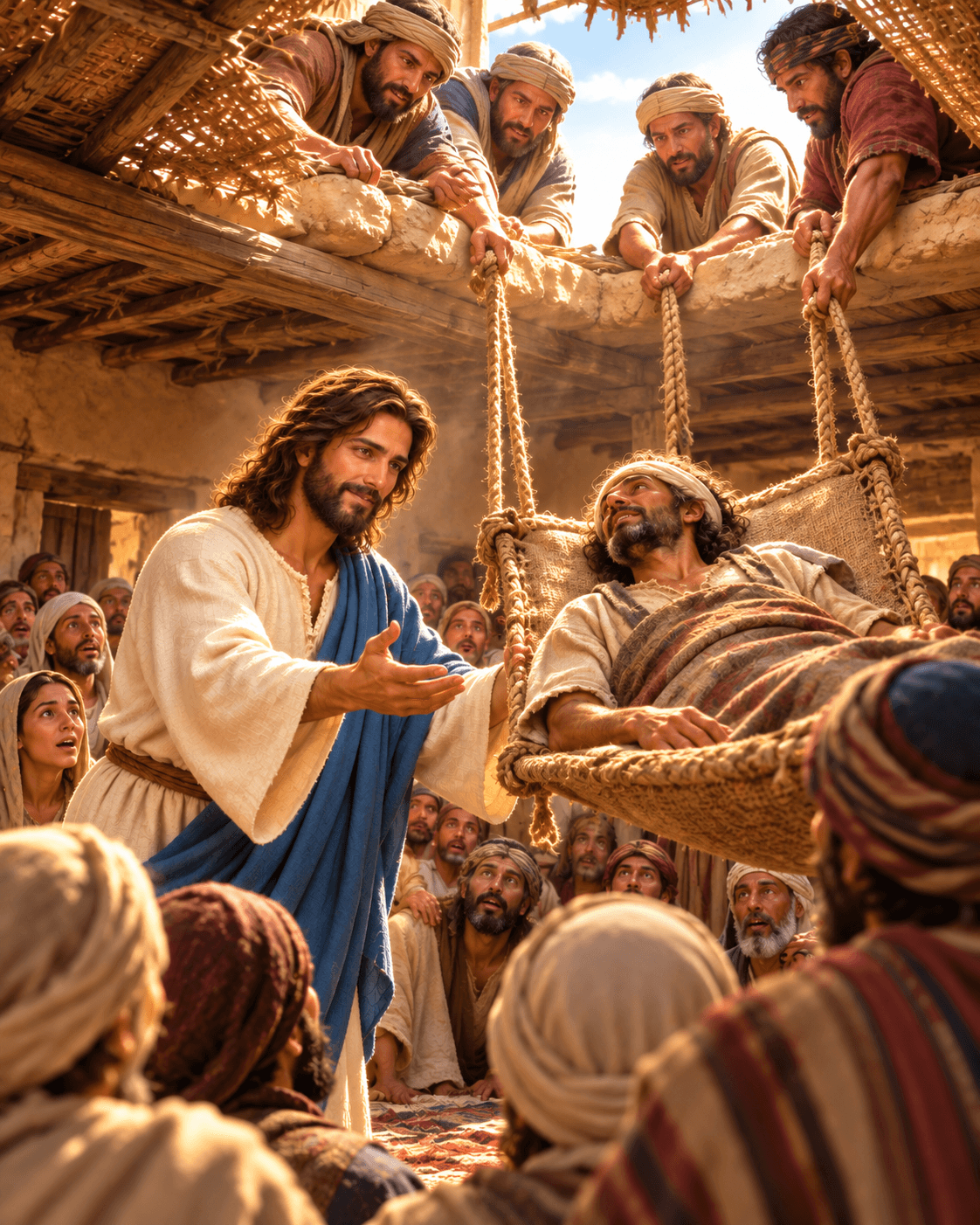
Illustrated scene from Jesus's story: Healing a Paralyzed Man (Mark 2:1–12)
Meet the people of the Bible
Follow their lives in order, with illustrated scenes and Bible passages that tell their stories.
 Jesus

Photo: zeevveez, via Wikimedia Commons. License: CC BY 2.0. Source. Location: Capernaum, on the northern shore of the Sea of Galilee. Resized for the web.
Explore the places of the Bible
See where biblical events happened, why each place matters, and what archaeology helps us understand.
Capernaum
Jesus' home base by the Sea of Galilee, and the town where Peter lived.
Get full access with one subscription
Explore the people and places of the Bible. Read summaries of every book, with images and clear explanations covering every chapter. Access all these features and our Bible study tools with one subscription.
See PlansAsk AI about Mark 2:9
Ask a question about this verse and get a clear answer, with Bible references you can read for yourself.
Every Bible book, explained chapter by chapter
Explore summaries of every book of the Bible, with images and easy-to-understand explanations covering every chapter.
Keep studying Mark 2:9
Related Bible verses
Key themes
Related topics
At a Glance — the Book of Mark
- Author
- John Mark
- Written
- Around AD 55-65
- Genre
- Gospel
- Original Audience
- Roman and Gentile Christians
Frequently Asked Questions
Quick, clear answers about this verse
What does Mark 2:9 mean?
Mark 2:9 presents Jesus asking which is easier: to forgive sins or to heal a paralyzed man. This illustrates His authority to perform both actions, emphasizing that forgiveness is as significant as physical healing.
What is the significance of forgiving sins in Mark 2:9?
In Mark 2:9, forgiving sins is highlighted as a profound act that requires divine authority, showing that spiritual healing is just as important as physical healing.
What does Jesus teach us in Mark 2:9?
In Mark 2:9, Jesus teaches that He has the power to forgive sins and heal, urging us to have faith in His ability to address both our physical and spiritual needs.
How does Mark 2:9 relate to faith?
Mark 2:9 emphasizes the importance of faith by showing that believing in Jesus' authority to forgive sins is crucial, just as believing in His ability to heal physically.
Daily Verse — straight to your inbox
A verse and a 2-sentence plain-English explanation, every morning. Free. Unsubscribe anytime.